
Retirement Contribution 2026: Stacking 401(k), IRA, Roth, and HSA

The 2026 limits open meaningful tax-advantaged space across five vehicles: 401(k), Traditional IRA, Roth IRA, HSA, and (for self-employed workers) the Solo 401(k). Stacking them correctly is the difference between a worker who shelters $30,000 in a year and one who shelters $72,000 — same income, same effort, materially different after-tax position. This guide walks through the math at four income levels and identifies the correct stacking order for each.
Source data: IRS Revenue Procedure 2025-xx; IRS COLA table (2026 contribution limits, verified against final IRS publication), Publication 590-A on IRA contributions, and Publication 590-B on IRA distributions. Citations are inline and at the end of the guide.
What this guide is. A structural breakdown of 2026 retirement-account limits and the tax math at common income levels. What it is not. A recommendation to use any specific account, a substitute for personal financial advice, or an estate or tax-planning strategy. Verify your own employer plan rules and consult a tax professional for filing decisions.
The Stack: Five Vehicles, Different Rules
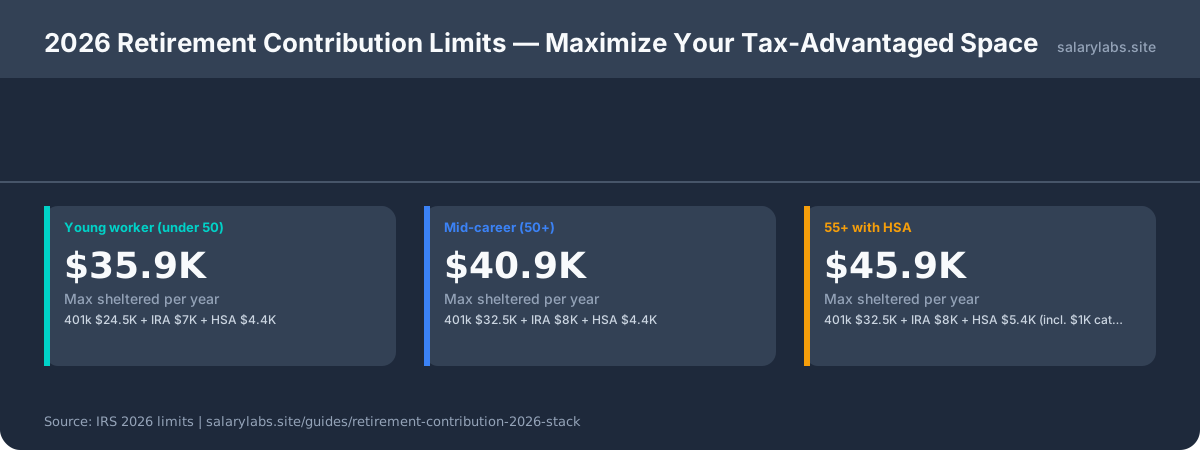
Each retirement vehicle has its own contribution limit, its own tax treatment, and its own access constraints. Knowing the rules separately is the prerequisite for stacking them correctly.
| Vehicle | 2026 limit | Tax treatment | Eligibility |
|---|---|---|---|
| 401(k) employee deferral | $24,500 ($32,500 age 50+; $11,250 enhanced for age 60-63) Verified IRS Rev. Proc. 2025-32 (2026 tax year) verified 2026-08-30 | Pre-tax (Traditional) or post-tax (Roth) | Employer plan must offer it |
| 401(k) total annual addition | $72,000 ($80,000 with catch-up) Verified IRS Rev. Proc. 2025-32 (2026 tax year) verified 2026-08-30 | Combined employee + employer + after-tax | Plan must allow after-tax contributions for the full $72,000 |
| Traditional + Roth IRA combined | $7,500 ($8,600 age 50+) Verified IRS Rev. Proc. 2025-32 (2026 tax year) verified 2026-08-30 | Pre-tax (Traditional, deduction phased out) or post-tax (Roth, contribution phased out) | Earned income required; phase-out income limits apply |
| HSA | $4,400 single / $8,750 family ($1,000 catch-up age 55+) Verified IRS Rev. Proc. 2025-32 (2026 tax year) verified 2026-08-30 | Triple-tax-free (pre-tax in, tax-free growth, tax-free out for medical) | HSA-qualified high-deductible health plan required |
| Solo 401(k) (self-employed only) | $72,000 total ($80,000 with catch-up) Verified IRS Rev. Proc. 2025-32 (2026 tax year) verified 2026-08-30 | Pre-tax or Roth employee portion + employer-side profit-sharing | Self-employment income; no W-2 employees other than spouse |
The five vehicles are additive when the worker qualifies for each. A 35-year-old W-2 worker with a 401(k), IRA eligibility (subject to MAGI), and HSA-qualified coverage can shelter up to $36,400 in a typical year through employee-side contributions alone. That breaks down as $24,500 in the 401(k), $7,500 in IRA space, and $4,400 in HSA. Add employer match and a partial after-tax 401(k) and the total often pushes north of $50,000 for many corporate workers.
The Tax Benefit Math
The tax benefit of each contribution differs by vehicle and by the worker's marginal rate. Understanding the dollar value of each shelter is the precondition for ordering them.
Traditional 401(k) and Traditional IRA. Pre-tax contributions reduce taxable income now, growing tax-deferred until withdrawal. A $1,000 contribution at the 24% federal bracket saves $240 of current-year tax, with state income tax saving stacking on top in most states.
Roth 401(k) and Roth IRA. Post-tax contributions provide no current-year deduction; growth and qualified withdrawals are tax-free. Roth IRA adds a unique flexibility — contributions (not earnings) can be withdrawn anytime without penalty.
HSA. Triple-tax-free: pre-tax in, tax-free growth, tax-free out for qualified medical expenses. After 65, non-medical withdrawals are taxed as ordinary income with no penalty. For workers facing meaningful retirement medical expenses, the HSA dominates other vehicles structurally for that portion of spending.
Compounded value example. A $7,500 contribution at age 35 invested at 7% real return for 30 years grows to roughly $53,300 in real terms. The Roth balance is fully tax-free at withdrawal; the Traditional balance owes ordinary income tax on the full amount. At a 22% retirement bracket, Roth wins by roughly $11,700 in net retirement income from that single contribution.
Risk-free benchmark for retirement planning. Long-dated U.S. Treasury bonds currently yield 3.45% (30-year), 3.35% (10-year Notes), and Bills yield 3.79% (short term, verified 2026-08-31 per Treasury Fiscal Data). This is the risk-free baseline that tax-advantaged retirement portfolios are benchmarked against. A common rule of thumb: a retirement portfolio diversified roughly 60/40 (equities/bonds) historically targets a 4% real withdrawal rate — at current 3.5% 30-year Treasury yield, the bond portion alone covers ~1.4% real return of that target before factoring the equity allocation. This is planning context, not investment advice.
Know your bracket first: The right contribution strategy depends on your marginal rate. Use the Income Percentile Calculator and Tax Estimator to confirm your bracket before choosing Roth vs traditional.
Marginal Rate Strategy
The Traditional vs Roth decision is a rate comparison, not preference. Two principles drive the choice:
- Traditional wins when current marginal rate > expected retirement rate. A worker in the 32% bracket retiring in the 22% bracket nets a 10-point arbitrage on every deferred dollar.
- Roth wins when current marginal rate < expected retirement rate. Workers in the 12% bracket today expecting 22%+ in retirement should pay tax now. Young workers and dual-income households heading toward peak earnings often fit this profile.
Most workers sit in the 22% federal bracket. Combined with 4-6% state tax, the marginal is roughly 26-28%. Retirement brackets, after Social Security plus modest investment income, often fall to 18-22% combined. The Traditional arbitrage is real but modest. Diversifying across both — usually weighted toward Traditional when employer match is involved — is defensible for most workers in the 22-24% range. Tax-rate uncertainty over a 30-year horizon argues for some Roth weighting as a hedge.
Worked Example: $80,000 Single, Age 35
A representative middle-income worker. Single filer, $80,000 W-2 income, age 35, employer offers a 401(k) with 4% match, has access to HSA-qualified health coverage. Federal marginal rate at this income is 22%. Combined with 5% state tax, marginal is 27%. FICA is not sheltered through retirement contributions.
| Account | Contribution | Tax saved (federal + state @ 5%) |
|---|---|---|
| 401(k) Traditional (to capture full match) | $8,000 (10% employee + 4% match = $11,200 total) | $2,160 (27% × $8,000) |
| Roth IRA | $7,000 | $0 current year (tax-free growth and withdrawal benefit captured at retirement) |
| HSA (single coverage) | $4,400 | $1,188 (27% × $4,400) |
| Total sheltered | $19,900 employee + $3,200 match | $3,348 current-year tax saved |
The stacking order. Traditional 401(k) first to capture the full employer match (a 100% immediate return on the matched portion that no other vehicle offers). Roth IRA next: the worker is in the 22% bracket — historically a low rate — and Roth weighting hedges against future bracket increases. HSA third: the triple-tax structure dominates for the medical-expense use case, but only after the higher-priority match-capture is secured. The worker who follows this order shelters $19,900 of their own contribution plus captures $3,200 of free employer money, with $3,348 in current-year tax savings.
Worked Example: $150,000 Single, Age 35
A higher-income single filer. $150,000 W-2 income, age 35, federal marginal rate 24%, with employer 401(k) and HSA-qualified coverage. Roth IRA contribution phases out between $153,000 and $168,000 MAGI for single filers in 2026. Traditional IRA deductibility for active workplace plan participants phases out between $81,000 and $91,000, so the deductible Traditional IRA is unavailable here.
The structural answer: contribute to a non-deductible Traditional IRA and convert it to Roth — the backdoor Roth strategy. A same-year contribute-and-convert produces near-zero taxable conversion amount, capturing Roth space the direct contribution would have phased out.
| Account | Contribution | Tax saved (federal 24% + state 5%) |
|---|---|---|
| 401(k) Traditional (full deferral) | $24,500 | $7,105 (29% × $24,500) |
| Backdoor Roth IRA (non-deductible Traditional → Roth conversion) | $7,500 | $0 current year, full Roth treatment going forward |
| HSA (single coverage) | $4,400 | $1,276 (29% × $4,400) |
| Total sheltered | $36,300 employee | $8,381 current-year tax saved |
The stacking shifts at this income because the IRA phase-outs change the math. The Traditional 401(k) is now the heaviest-shelter vehicle ($24,500 at 24% marginal saves more than four times what the IRA contribution would). The backdoor Roth captures IRA space direct contribution cannot. Notable: the pro-rata rule applies when the worker has any pre-tax balance in any IRA across all accounts; this complicates the strategy and is one reason workers consolidate IRA balances or roll Traditional IRA money into employer plans before executing backdoor Roth. The Backdoor Roth IRA Calculator runs the full IRS Form 8606 line-by-line, applies the §408(d)(2) pro-rata rule, and computes the cleanout savings for a fully tax-free conversion.
Worked Example: $200,000 Single, Age 35
A high-income single filer. $200,000 W-2 income, age 35, federal marginal rate 32%. Combined federal plus state plus FICA on additional earnings is approximately 39.65%. The worker has access to a 401(k) with after-tax contribution allowance (mega backdoor Roth) and HSA- qualified coverage. Direct Roth IRA is fully phased out; backdoor Roth remains available.
| Account | Contribution | Tax saved (federal 32% + state 6%) |
|---|---|---|
| 401(k) Traditional (full elective deferral) | $24,500 | $9,310 (38% × $24,500) |
| Employer match (assume 5% on $200,000) | $10,000 | $0 (employer-side, not from worker income) |
| After-tax 401(k) → in-plan Roth conversion (mega backdoor) | $37,500 (to fill $72,000 total annual addition limit: $24,500 + $10,000 + $37,500) | $0 current year, full Roth treatment after conversion |
| Backdoor Roth IRA | $7,000 | $0 current year, Roth growth and withdrawal |
| HSA (single coverage) | $4,400 | $1,672 (38% × $4,400) |
| Total sheltered | $70,900 employee + $10,000 match | $10,982 current-year tax saved + Roth growth |
At this income level the after-tax 401(k) plus in-plan Roth conversion (the mega backdoor Roth) dominates. It is only available when the employer plan permits both after-tax contributions beyond the $24,500 elective deferral and in-plan Roth conversion or in-service withdrawal. Many large-employer plans offer this; many smaller plans do not. When available, it lets the worker fill the $72,000 total annual addition limit entirely with Roth-treated balances — a strategically strong position decades from retirement.
For a 1099 self-employed worker at this income level, a Solo 401(k) replicates much of the same structure: $24,500 employee deferral plus up to 25% of net self-employment income as employer-side profit-sharing, both pre-tax or Roth, potentially reaching the $72,000 limit on its own.
Worked Example: $50,000 Single, Age 25
A young, lower-income worker. $50,000 W-2 income, age 25, federal marginal rate 12%, with employer 401(k) and HSA-qualified coverage. Direct Roth IRA is fully available; phase-out begins at $153,000 MAGI for single filers.
| Account | Contribution | Tax saved (federal 12% + state 4%) |
|---|---|---|
| 401(k) Roth (capture full employer match, ~$2,000 at 4%) | $5,000 employee + $2,000 match | $0 current year (Roth, no current deduction); growth tax-free |
| Roth IRA | $7,000 | $0 current year; growth and withdrawal tax-free |
| HSA (single coverage) | $4,400 | $704 (16% × $4,400) |
| Total sheltered | $16,400 employee + $2,000 match | $704 current-year tax saved + decades of Roth growth |
At 12% marginal, Traditional 401(k) deferral saves only $0.12 per dollar today. Over a 40-year compounding horizon, the worker's retirement bracket is unlikely to be lower, and is plausibly higher with Social Security plus modest investment income. Roth is the structurally favored vehicle. The 401(k) Roth still captures the employer match (which often goes into the Traditional side regardless of employee election) and the worker's deferred portion grows tax-free for 40 years. The current-year tax saving is modest; the 40-year compounding of fully Roth balances is the real prize.
Catch-Up Contributions Age 50+ and 60-63
The 2026 catch-up structure has two distinct tiers under SECURE 2.0.
- Age 50-59 and 64+. Standard catch-up of $8,000 on the 401(k) elective deferral, raising the limit from $24,500 to $32,500. IRA catch-up of $1,100 (limit $8,600). HSA catch-up of $1,000 at age 55+ (single limit $5,400).
- Age 60-63 enhanced 401(k) catch-up. SECURE 2.0 sets a higher catch-up for this four-year window — the greater of $10,000 or 150% of the regular catch-up, approximately $11,250 for 2026. The 401(k) elective deferral limit becomes $35,750. It reverts to the standard $8,000 at age 64.
- Roth requirement for high earners. Workers earning more than $150,000 in FICA wages from the same employer in the prior year (indexed from the $145,000 statutory base in SECURE 2.0 per IRS Notice 2025-67) must take their 401(k) catch-up as Roth, not Traditional. The regular elective deferral remains optional Traditional or Roth.
The catch-up tiers are significant for late-career workers. A 62-year-old maximally using the enhanced 401(k) catch-up plus IRA catch-up plus HSA catch-up shelters $35,750 + $8,600 + $5,400 = $49,750 per year through employee-side contributions alone, before any employer match — potentially $199,000 of additional tax-advantaged capacity over the four-year 60-63 window.
The Required Minimum Distribution Reset
Required Minimum Distributions (RMDs) force taxable withdrawals from pre-tax retirement accounts starting at age 73 (applies to individuals who attain age 73 before January 1, 2033). The RMD age rises to 75 starting January 1, 2033, for individuals who attain age 74 after December 31, 2032 (SECURE 2.0 Act Section 107). The withdrawal is taxed as ordinary income and can push retirement income into a higher bracket than expected.
The structural answer: Roth accounts have no RMD during the original owner's lifetime. Roth IRAs are exempt entirely. Roth 401(k) accounts are exempt during the owner's lifetime starting in 2024 (SECURE 2.0). Workers who anticipate large retirement balances and want flexibility on when (and whether) to draw them down benefit from some Roth weighting. The asymmetry is real: large Traditional balances cannot avoid the RMD; large Roth balances can be left untouched, growing tax-free, and passed to heirs subject to the SECURE Act 10-year inherited-account rule.
Limitations
- Plan-specific rules. After-tax contributions, in-plan Roth conversion, in-service withdrawals, and Roth 401(k) availability are plan options the employer may or may not offer. The mega backdoor Roth in the $200,000 example assumes both after-tax contributions and conversion are permitted; many plans permit one without the other, or neither. Verify your specific plan documents before assuming the strategy is available.
- Pro-rata rule on backdoor Roth. The IRA pro-rata rule treats all Traditional, SEP, and SIMPLE IRA balances as a single pool when calculating taxable portion of any Roth conversion. The strategy works cleanly only when pre-tax IRA balances are zero or have been rolled into an employer 401(k) plan first.
- State tax treatment varies. California and New Jersey do not recognize HSA pre-tax status for state income tax. Some states tax Roth conversions; some treat HSA contributions differently from federal. Actual state tax savings depend on residence.
- Tax law change risk. The 2026 limits and bracket structure depend on the legislative outcome of TCJA expiration after 2025. Verify against the final IRS publication before filing. Long-horizon Roth-vs-Traditional decisions also bear future-law uncertainty.
- This guide is not personal advice. Individual decisions depend on specific employer plan, state of residence, expected retirement income mix, healthcare situation, family structure, and estate plans. Consult a qualified tax professional or fee-only fiduciary advisor for decisions tied to your specific situation.
Related Tools and Guides
- Retirement Contribution Stack Calculator — interactive version of this guide. Enter your income, age, and match% to see the 2026 stacking math personalized to your situation.
- Backdoor Roth IRA Calculator — for high earners above the $168K (single) or $252K (MFJ) Roth IRA phase-out. Runs the full IRS Form 8606 line-by-line, applies the §408(d)(2) pro-rata rule, and shows the cleanout savings for a fully tax-free conversion.
- Take-Home Pay Calculator — model how a Traditional 401(k) deferral changes federal and state withholding
- Healthcare Premium and Take-Home Pay 2026 — the HSA-qualified high-deductible plan tradeoff in context
- Self-Employment Tax: 1099 vs W-2 (2026) — Solo 401(k) and SEP-IRA structures for self-employed workers
- What is FICA Tax — why the 7.65% FICA portion is not sheltered by 401(k) contributions
Sources
- IRS Revenue Procedure 2025-xx; IRS COLA table, 2026 retirement plan contribution limits — verify against final IRS publication
- IRS Publication 590-A: Contributions to Individual Retirement Arrangements (IRAs)
- IRS Publication 590-B: Distributions from Individual Retirement Arrangements (IRAs)
- IRS Retirement Plans — current rules, contribution limits, and plan type comparison
- Social Security Administration — context for retirement income in combination with employer-plan and IRA balances
- Income Breakdown Calculator
- Take Home Pay Calculator
- SECURE 2.0 Act of 2022 — enhanced catch-up provisions, Roth 401(k) RMD elimination, RMD age changes