
Salary vs Hourly Pay: Which Structure Is Better for You?

When you receive a job offer or consider a career move, one of the most consequential decisions is whether to accept salaried or hourly compensation. The two structures differ in how and when you're paid, how overtime is handled, what benefits you receive, and how your taxes are withheld. Understanding the differences helps you evaluate any offer accurately — not just the headline number.
Use this guide when: you are comparing two offers, re-pricing a promotion, or checking whether a fixed salary still makes sense once real working hours are included. Use calculators next: when you want to convert an offer into an hourly equivalent or estimate the after-tax difference.
What Is a Salaried Position?
A salaried employee receives a fixed annual amount, paid out in equal installments regardless of the exact number of hours worked. If you work 35 hours one week and 50 hours the next, your paycheck stays the same.
Key characteristics of salaried employment:
- Predictable, stable income every pay period
- Benefits package — health insurance, dental, vision, 401(k) matching, and paid time off (PTO) are standard in salaried roles
- Exempt from overtime in most cases (FLSA "exempt" classification)
- Higher perceived status and clearer path to management
- No extra pay for extra hours — a key trade-off in demanding industries
Salaried workers are often classified as exempt under the Fair Labor Standards Act (FLSA). That means they are not entitled to overtime pay. The exemption is not automatic. It depends on the federal salary-basis threshold, the duties test, and any stricter state rules.
What Is Hourly Pay?
An hourly worker is paid for each hour worked. Their weekly earnings vary based on hours clocked. Hourly employees are usually classified as non-exempt under the FLSA. That means they earn overtime pay at 1.5× their regular rate for any hours beyond 40 in a workweek.
Key characteristics of hourly employment:
- Variable income — pay fluctuates with hours worked
- Overtime pay — 1.5× for hours over 40 per week (federally required for non-exempt workers)
- Transparent time-to-pay ratio — you know exactly what each hour is worth
- Flexibility in some industries (retail, healthcare, construction)
- Benefits may be limited for part-time hourly workers
Salary vs Hourly: The Money Comparison
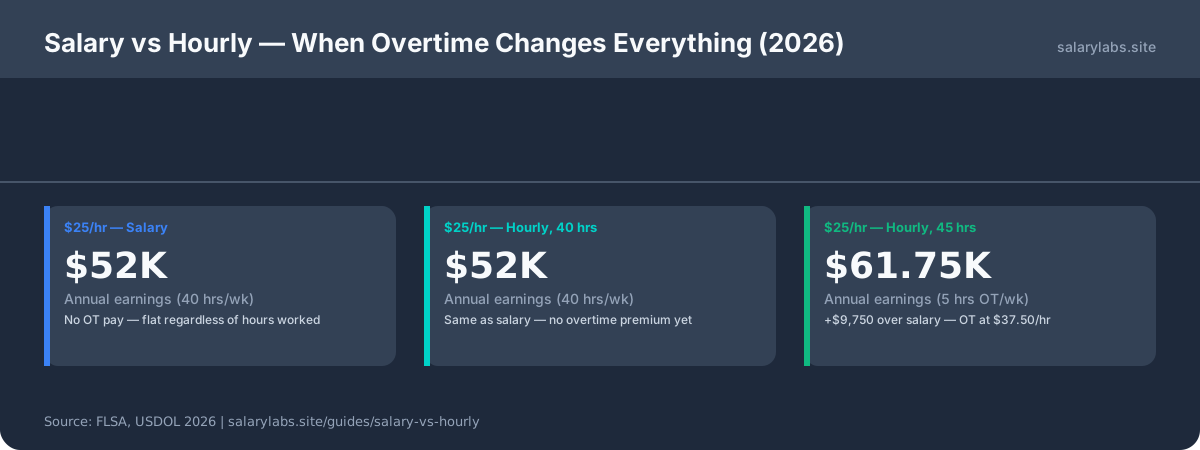
View data table
| Badge | Value | Label |
|---|---|---|
| $25/hr — Salary | $52K | Annual earnings (40 hrs/wk) |
| $25/hr — Hourly, 40 hrs | $52K | Annual earnings (40 hrs/wk) |
| $25/hr — Hourly, 45 hrs | $61.75K | Annual earnings (5 hrs OT/wk) |
The fastest way to compare the two structures is to normalize them to the same hourly value. The examples below show how different scenarios lead to different winners. The key is that neither model is universally better.
Example A: The same job — $25/hour equivalent — regular 40-hour weeks
Let us say you receive two offers for the same project manager role. The employer offers two ways to structure the same compensation:
| Salaried | Hourly | |
|---|---|---|
| Annual gross | $52,000 | $52,000 (40 hrs × $25 × 52) |
| Hours per week | ~40 (assumed) | Exactly 40, paid OT if over |
| Effective hourly rate | $25.00 | $25.00 |
| Overtime pay | None (assumed exempt) | 1.5× ($37.50/hr) if over 40 |
| Annual if you work 45 hrs/week | $52,000 (still $52K) | ~$60,500 (extra 5 hrs × $37.50 × 52) |
In this scenario, if you consistently work 45 hours a week, the hourly structure earns you $8,500 more per year — even though the headline rate is identical. That is the overtime premium at work.
Example B: When salaried wins — strong benefits offset the overtime gap
But salary can still win the total compensation picture. Consider the same hourly worker offered a salaried role with these extras:
| Compensation element | Hourly job (no extras) | Salaried job (with benefits) |
|---|---|---|
| Cash pay (45 hrs/week scenario) | $60,500 | $52,000 |
| Health insurance value | $0 (no employer plan) | +$6,000 |
| 401(k) match (4%) | $0 | +$2,080 |
| Paid vacation (2 weeks) | −$2,000 (unpaid time off) | Included at full pay |
| Total compensation | ~$58,500 | ~$60,080 |
In this example, the salaried position wins even though the hourly job pays more cash — because the benefits package is worth real money. The break-even point depends on how you value health coverage, retirement matching, and paid time off.
The fair conclusion: Hourly pay often wins when overtime is frequent. Salaried pay often wins when the benefits package is strong and your hours stay close to 40. To know which one is right for you, convert both offers to the same unit — an effective hourly rate — before deciding.
- Fixed pay regardless of hours worked
- Usually includes health, 401(k), PTO
- Overtime rarely paid (exempt status)
- Stronger path to management roles
- Extra hours cost you — not your employer
- Pay scales exactly with hours worked
- Overtime at 1.5× for hours over 40/week
- Benefits less common for part-time
- More schedule flexibility in some roles
- Every extra hour has a clear dollar value
Use our free calculators to compare: Enter any salary in the Salary Calculator to find the effective hourly rate, or use the Hourly to Salary Calculator to project annual earnings from an hourly rate including overtime.
Benefits and Total Compensation
Raw pay is only part of the picture. Total compensation includes all monetary and non-monetary benefits, which can add 20–40% to the value of a base salary:
- Health insurance: Employer-sponsored health coverage can be worth $5,000–$15,000/year
- 401(k) matching: A 4% match on a $70,000 salary = $2,800/year in free money
- Paid time off (PTO): 2 weeks of paid vacation = ~4% of annual salary
- Remote work flexibility: Saves commuting costs and time — often worth $3,000–$8,000/year
- Professional development: Tuition reimbursement, conference budgets, certifications
Hourly workers — especially part-time — are less likely to receive employer-sponsored health insurance or retirement matching. As a result, an hourly role with a higher nominal rate can be worth significantly less than a salaried position with strong benefits.
Tax Treatment: Salary vs Hourly
There is no difference in how salary and hourly income are taxed. Both count as ordinary income. Both are subject to the same federal income tax brackets (10%–37%), state income taxes, Social Security (6.2%) — learn more in our FICA Tax guide, and Medicare (1.45%).
The practical difference shows up in withholding consistency. Salaried employees have predictable withholding each pay period. Hourly workers with variable hours may have inconsistent withholding. That can result in owing taxes at year-end or receiving a larger-than-expected refund.
When to Choose Salary vs Hourly
Neither model is universally better. The right answer depends on your expected hours, benefits, and whether you are paid for extra effort or simply asked to absorb it.
Choose Salaried if You:
- Value income predictability and financial planning stability
- Want full employer-sponsored benefits
- Are pursuing management, leadership, or career advancement
- Typically work close to 40 hours and won't be penalized for slightly less
- Want to build toward senior roles or ownership tracks
Choose Hourly if You:
- Regularly work overtime and want direct compensation for extra hours
- Want clear, transparent pay-for-time accountability
- Work in industries with fluctuating demand (healthcare, construction, retail)
- Are in a contract or freelance arrangement
- Prefer schedule flexibility or are working multiple jobs
What this page does not decide for you: title progression, equity upside, schedule quality, commute burden, and manager quality can outweigh a small pay difference. Use this guide to frame the economics. Then price the non-cash tradeoffs honestly.
Salary vs Hourly Pay Questions
Use the questions below to pressure-test the pay structure, then move into the tool set that converts the tradeoff into real hourly value, overtime exposure, and after-tax context.
Related data: Understanding minimum wage context helps when evaluating hourly offers. See our Minimum Wage by State 2026 guide for the legal floor in your state, and Average Salary by State for the broader market context.