
2026 Federal Income Tax Brackets

The IRS adjusts federal tax brackets each year for inflation. For 2026, these brackets apply to income earned during the 2026 tax year and help explain how federal income tax is calculated.
The US uses a progressive (marginal) tax system — you don't pay your top rate on all income. Only the income that falls within each bracket is taxed at that rate.
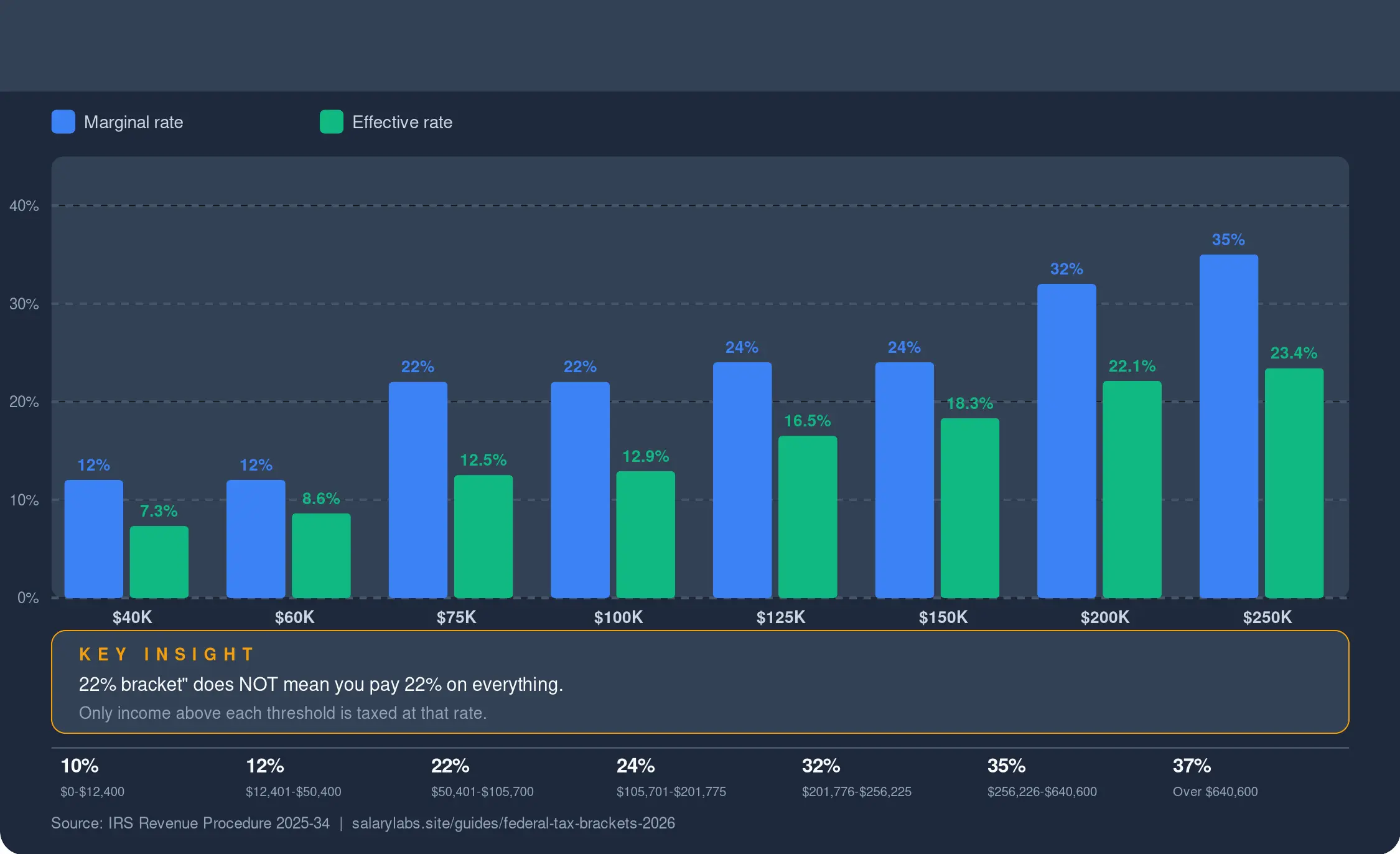
Key concept: Being in the "22% bracket" doesn't mean you pay 22% on everything. It means your income above the 12% threshold is taxed at 22%. Most people's effective tax rate is several points lower than their marginal rate.
Use this guide when: you need to understand the bracket ladder, compare filing statuses, or sanity-check a planning assumption. Do not use it as a withholding replica: payroll systems, credits, itemizing, and local taxes can move the actual result materially.
Why this guide exists on SalaryLabs: federal brackets are one of the most misunderstood pieces of paycheck math. We keep this page as a flagship guide because many workers reach a wrong conclusion at the exact moment they hear "22% bracket" or "24% bracket." This page is here to slow that interpretation down, show the ladder clearly, and connect the bracket theory to the calculators that turn it into a real take-home estimate.
2026 Tax Brackets — Single Filers IRS Rev. Proc. 2025-32 (2026 tax year)
| Tax Rate | Taxable Income Range | Tax on This Bracket |
|---|---|---|
| 10% | $0 – $12,400 | Up to $1,240 |
| 12% | $12,401 – $50,400 | Up to $4,560 |
| 22% | $50,401 – $105,700 | Up to $12,166 |
| 24% | $105,701 – $201,775 | Up to $23,058 |
| 32% | $201,776 – $256,225 | Up to $17,424 |
| 35% | $256,226 – $640,600 | Up to $134,531.25 |
| 37% | Over $640,600 | 37% on excess |
2026 Tax Brackets — Married Filing Jointly
| Tax Rate | Taxable Income Range | Tax on This Bracket |
|---|---|---|
| 10% | $0 – $24,800 | Up to $2,480 |
| 12% | $24,801 – $100,800 | Up to $9,120 |
| 22% | $100,801 – $211,400 | Up to $24,332 |
| 24% | $211,401 – $403,550 | Up to $46,116 |
| 32% | $403,551 – $512,450 | Up to $34,848 |
| 35% | $512,451 – $768,700 | Up to $89,687.50 |
| 37% | Over $768,700 | 37% on excess |
2026 Standard Deductions
Before applying tax brackets, you subtract the standard deduction from gross income:
| Filing Status | 2026 Standard Deduction |
|---|---|
| Single | $16,100 |
| Married Filing Jointly | $32,200 |
| Married Filing Separately | $16,100 |
| Head of Household | $24,150 |
Real Examples: What You Actually Pay
The worked examples below use IRS-published 2026 brackets and standard deduction figures from Rev. Proc. 2025-32. IRS Rev. Proc. 2025-32 (2026 tax year) They illustrate the marginal-vs-effective distinction and how progressive brackets actually compute. Use the calculator below to try your own income.
Example 1: Single Filer, $60,000 Gross Income
− $16,100 standard deduction
= $43,900 taxable income
10% on $12,400 = $1,240.00
12% on $31,500 ($43,900 − $12,400) = $3,780.00
Total federal tax: $5,020.00
Effective rate: 8.4% of gross / 11.4% of taxable income
Example 2: Single Filer, $100,000 Gross Income
− $16,100 standard deduction
= $83,900 taxable income
10% on $12,400 = $1,240.00
12% on $38,000 = $4,560.00
22% on $33,500 ($83,900 − $50,400) = $7,370.00
Total federal tax: $13,170.00
Effective rate: 13.2% of gross / 15.7% of taxable income
Example 3: Married Filing Jointly, $150,000 Combined Income
− $32,200 standard deduction
= $117,800 taxable income
10% on $24,800 = $2,480.00
12% on $76,000 = $9,120.00
22% on $17,000 ($117,800 − $100,800) = $3,740.00
Total federal tax: $15,340.00
Effective rate: 10.2% of gross
See your breakdown: Use the Income Breakdown tool to see federal income tax, FICA, and state tax as separate line items for any salary.
Effective vs Marginal Tax Rate
Your marginal rate is the rate on your last dollar of income — the highest bracket you reach. Your effective rate is total tax ÷ total income.
| Gross Income (Single) | Marginal Rate IRS Rev. Proc. 2025-32 (2026 tax year) | Effective Rate Derived | Federal Tax Owed Computed |
|---|---|---|---|
| $40,000 | 12% | ~7.1% | ~$2,840 |
| $60,000 | 12% | ~8.6% | ~$5,162 |
| $80,000 | 22% | ~11.3% | ~$9,060 |
| $100,000 | 22% | ~13.6% | ~$13,614 |
| $150,000 | 24% | ~18.3% | ~$27,450 |
| $200,000 | 32% | ~22.2% | ~$44,400 |
Use our Tax Estimator to calculate your exact federal and state tax for your specific income and filing status. Or use the Take Home Pay Calculator to see your net paycheck after all taxes.
How SalaryLabs Expects You to Use This Guide
This page is not meant to end the decision by itself. It is the explanation layer inside a larger workflow:
- Read this guide first if you need to understand the bracket structure and why marginal vs effective rate are different.
- Use the Tax Estimator next if you need a directional federal + state split for your own inputs.
- Use Take Home Pay after that if the question becomes monthly budget reality or offer comparison.
That separation is intentional. SalaryLabs tries to keep the article, the estimator, and the paycheck view doing different jobs instead of pretending one page can do everything accurately for every worker.
Other Taxes That Affect Your Paycheck
Federal income tax is just one piece. Your total paycheck deductions also include:
- FICA — Social Security (6.2%): On wages up to $184,500 in 2026 Verified SSA Wage Base (2026)
- FICA — Medicare (1.45%): On all wages, no cap Verified SSA Wage Base (2026)
- State income tax: 0% to 13.3% depending on state
- Local taxes: Some cities (NYC, Philadelphia, Detroit) have additional income taxes
Learn more about FICA in our complete FICA Tax guide.
What Could Change After 2026?
The 2026 tax brackets reflect current law as of early 2026. Several provisions from the 2017 Tax Cuts and Jobs Act (TCJA) are scheduled to sunset or be revised. Key items to watch:
- Standard deduction: The current 2026 standard deduction ($16,100 single / $32,200 married filing jointly / $24,150 head of household) reflects the inflation-adjusted amounts under current law. If Congress allows major TCJA-era individual provisions to sunset or revises them, taxable income for many filers would rise.
- Marginal rates: Some individual income tax rates could revert upward. For example, the current 22% bracket rate could return to 25% for some income ranges.
- Child Tax Credit: The expanded CTC may be reduced if TCJA provisions expire. This does not affect brackets but does affect final tax owed.
- AMT thresholds: Alternative Minimum Tax exemptions would drop significantly, affecting more middle- and upper-income filers.
Recommendation: These brackets are accurate for tax year 2026. If you're doing multi-year tax planning or projecting income beyond 2026, consult a tax professional about potential legislative changes. IRS.gov publishes official inflation adjustments each fall for the following tax year.
What this page does not model: tax credits, itemized deductions, capital gains treatment, AMT interactions for specific households, or the exact withholding pattern your employer uses on each paycheck. Use it to understand the layers first, then run your own numbers with the Tax Estimator.
Federal Tax Bracket Questions
Once the ladder is clear, the next useful move is to translate brackets into your own paycheck, compare them with payroll taxes, and see how the same salary behaves across states.