Learn how to read your pay stub line by line — gross pay, federal withholding, FICA, state tax, deductions, and net pay. Includes real examples for 2026.
Sources cited
2026 data
Updated June 2026
'IRS · BLS · SSA'
Independent Salary Data Researcher
Published Jan 15, 2026
Updated Jul 21, 2026
Maintained by the author using IRS Publication 15-T, SSA wage-base announcements, and BLS OEWS data.
All calculator formulas are deterministic JavaScript — no AI inference in the numbers.
Content is reviewed for accuracy when tax figures are updated annually. See Methodology · Author Profile
Most Americans receive a paycheck every two weeks — and most never fully understand what's on it.
Your pay stub contains critical financial information: how much you earned, how much was withheld,
and where each dollar went. Understanding it takes less than 10 minutes and could save
you from costly tax surprises.
This guide walks through every section of a typical US pay stub, with real examples based on
a $75,000/year salary paid bi-weekly in 2026.
$2,884.62
Biweekly gross — $75,000 annual salary, 2026
Example: actual net depends on your W-4 elections and state
Interactive Evidence
Pay stub anatomy at a glance
Use this panel to orient yourself before reading the full guide. Each row maps to a part of a standard pay stub and explains why that line matters when you review a real paycheck.
Bi-weekly pay stub example
$75,000 annual salary · California withholding example
Net pay$1,573.14
Gross earnings are the anchor line. Start there before deciding whether the rest of the stub looks reasonable, because every tax and deduction line is calculated from that base in one form or another.
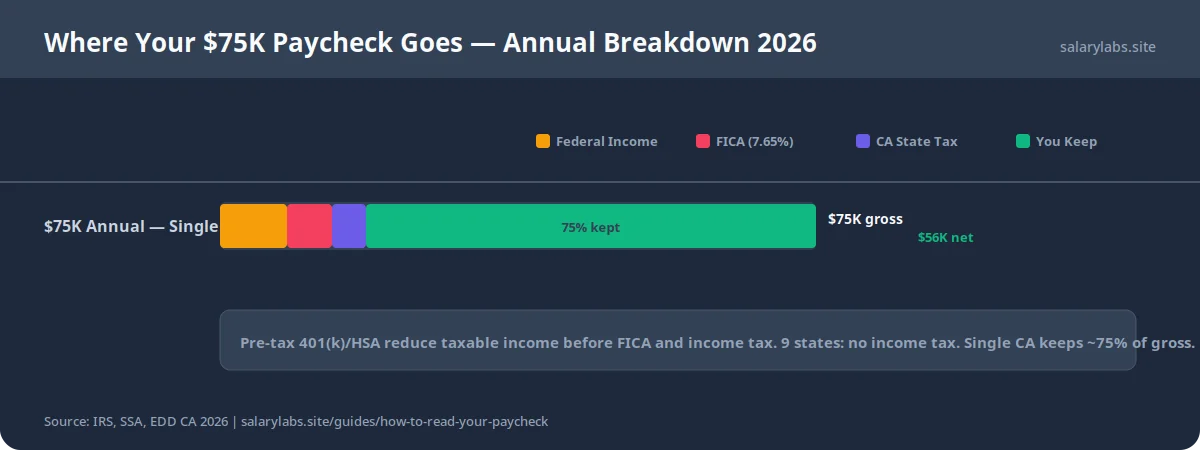
Where Your $75K Paycheck Goes — Annual Breakdown 2026 — salarylabs.site
The Anatomy of a Pay Stub
6+ linesTypical number of deduction lines on a US pay stub
Bi-weeklyMost common pay frequency for salaried US workers
YTDYear-to-date totals — key for tax planning
$75,000 / yr — Bi-Weekly Pay Stub Snapshot
Gross Pay
Regular pay$2,884.62
Bi-weekly gross$2,884.62
−
Taxes + Deductions
Federal tax−$389.61
OASDI / SS (6.2%)−$178.85
Medicare (1.45%)−$41.83
State tax (CA)−$173.08
401(k) + benefits−$528.11
Total out−$1,311.48
=
Net Pay
This paycheck$1,573.14
Annualized~$40,902
% kept~54.5%
Every US pay stub has the same core sections, though the exact layout varies by employer:
Employee & Employer Info — your name, address, employer name, pay period dates
Tax Deductions — federal, state, and FICA withholding
Pre-Tax Deductions — 401(k), health insurance, HSA
Post-Tax Deductions — Roth 401(k), life insurance, garnishments
Net Pay — your take-home amount
YTD Totals — cumulative year-to-date figures
Section 1: Earnings
The earnings section shows what you made before any deductions. For a $75,000 salary paid bi-weekly:
Description
Hours
Rate
Current
YTD
Regular Pay
80
$36.06
$2,884.62
$17,307.72
Overtime
0
$54.09
$0.00
$0.00
Gross Pay
$2,884.62
$17,307.72
Gross pay = your salary ÷ 26 for bi-weekly employees. A $75,000 salary ÷ 26 pay periods = $2,884.62 per paycheck. Use our Salary Calculator to verify your own figure.
Section 2: Tax Deductions
This section shows all government-mandated withholdings:
Tax
Current
YTD
Notes
Federal Income Tax
$389.61
$2,337.66
Based on W-4 + brackets
OASDI / Social Security
$178.85
$1,073.10
6.2% of gross
Medicare
$41.83
$250.98
1.45% of gross
State Income Tax (CA)
$144.23
$865.38
Varies by state
State SDI (CA)
$28.85
$173.10
State disability insurance
Total Taxes
$783.37
$4,700.22
Federal Income Tax
This is the biggest variable on your pay stub. The amount withheld depends on your
W-4 elections — your filing status (single, married, head of household)
and any additional withholding you requested. The IRS tax tables determine the base amount.
If your federal withholding seems wrong, check your W-4 with HR. You can update it at any time
and the new withholding takes effect on the next payroll cycle.
OASDI (Social Security)
OASDI stands for Old Age, Survivors, and Disability Insurance — the official name for Social
Security. It's always 6.2% of your gross pay, up to the annual wage base ($184,500 in 2026).
Once your YTD earnings hit this threshold, Social Security withholding stops for the rest of the year.
Medicare
Always 1.45% of gross pay with no wage cap. High earners (over $200,000 for single filers)
pay an additional 0.9% surtax, which employers begin withholding once your wages exceed $200,000.
State Income Tax
Varies significantly by state. Nine states have no income tax (FL, TX, NV, WA, AK, WY, SD, TN, NH).
Others range from a flat 3–5% to progressive rates up to 13.3% in California.
Section 3: Pre-Tax Deductions
These reduce your taxable gross pay, lowering your tax bill:
Deduction
Current
YTD
Annual Limit (2026)
401(k) Contribution
$288.46
$1,730.76
$23,500
Health Insurance (medical)
$125.00
$750.00
No limit (employer plan)
Dental Insurance
$18.50
$111.00
No limit
HSA Contribution
$96.15
$576.90
$4,300 (self-only)
Total Pre-Tax
$528.11
$3,168.66
Pre-tax deductions save you money. If you contribute $288 to your 401(k) each paycheck, you're not just saving for retirement — you're also reducing your federal taxable income, which means you pay less in federal income tax right now.
See exactly what hits your bank account. Every pay stub section above — use the take-home pay calculator to plug in your actual salary, state, and pre-tax deductions and see the real net.
The YTD column shows cumulative totals since January 1. Use it to:
Verify your W-2 at tax time — YTD totals on your last paycheck of the year should match Box 1 (wages) and Box 4 (SS withheld) on your W-2
Track Social Security cap — when YTD gross hits $184,500, your OASDI withholding stops
Monitor 401(k) contributions — make sure you don't accidentally exceed the $23,500 annual limit
Spot errors early — if a deduction looks wrong, catch it before it compounds over the full year
Common questions and next step
1
Find your gross earnings line
This is the anchor. Every tax and deduction is calculated from this number. Verify it matches your expected pay rate × hours.
2
Check your FICA withholding
Should be 6.2% Social Security + 1.45% Medicare = 7.65% of gross. If YTD gross exceeds $184,500, SS stops.
3
Verify federal + state withholding
These vary by W-4 elections. Check that your filing status and allowances match what you intended when you filled out the form.
4
Review pre-tax deductions
401(k), health insurance, HSA — confirm the amounts match your elections. These reduce taxable income.
Net pay = what hits your account
Gross minus all deductions. If it looks wrong, start from gross and work down. Most errors are in the pre-tax deduction layer.
The Pay Stub Rule
Start at gross. Work down. Most errors live in the pre-tax deduction layer.
Most paycheck surprises come from pre-tax deductions changing — a new health plan, a 401(k) increase,
or an HSA election. Your gross pay is usually stable. Your net pay changes when your elections change.
Read both YTD and current-period columns to catch issues early.
Use these questions to confirm the labels you are seeing on the stub, then move directly into the calculator or explainer that helps you apply the numbers.
What is the difference between gross and net pay?
Gross pay is total earnings before any deductions. Net pay is what you typically receive after federal tax, state tax, FICA, and voluntary deductions are removed. For most workers, net pay is 70–80% of gross pay.
What does YTD mean on a paycheck?
YTD = Year-to-Date. It shows cumulative totals from January 1 through your current pay date. Your final paycheck of the year's YTD should match your W-2 figures.
Why does my paycheck say OASDI?
OASDI (Old Age, Survivors, and Disability Insurance) is the official name for Social Security tax — 6.2% of gross wages up to $184,500 in 2026. Some employers label it "SS Tax" or "Social Security."
What is a W-4 and how does it affect my paycheck?
Your W-4 tells your employer how much federal tax to withhold. Filing status (single vs married) and claimed dependents affect your withholding amount. Too little withheld means you'll owe at tax time; too much means a refund. You can update your W-4 anytime through HR.
My federal withholding seems too high — what should I do?
Update your W-4 with your employer. Use the IRS Tax Withholding Estimator at irs.gov to calculate the right withholding for your situation. If you're consistently getting large refunds, you're over-withholding — that's an interest-free loan to the government.
See the math behind your pay stub in action: run your actual numbers through these calculators to understand what each line item means for your bottom line.
Data & Methodology: Salary data sourced from the Bureau of Labor Statistics (BLS) Occupational Employment and Wage Statistics program. Tax figures reflect 2026 IRS rates. This content is for informational purposes only — not professional tax, legal, or financial advice. Consult a qualified professional for guidance specific to your situation.