Independent Salary Data Researcher
Published Jan 15, 2026
Updated Jul 21, 2026
Maintained by the author using IRS Publication 15-T, SSA wage-base announcements, and BLS OEWS data.
All calculator formulas are deterministic JavaScript — no AI inference in the numbers.
Content is reviewed for accuracy when tax figures are updated annually. See Methodology · Author Profile
Software engineer pay is hard to summarize cleanly because the title covers a wide spread of work. A junior developer at a regional company, a backend engineer at a public tech firm, and an AI engineer at a top lab do not sit in the same market even if the title looks similar.
Median Base
$140K
Directional mid-level base benchmark, not a universal national quote.
Cost-Adjusted Hotspots
Austin / Raleigh
A reminder that gross pay and real value are different comparisons.
Top Specialty
AI / ML
One of the strongest premium paths when the work has real production scope.
$140K
Directional SWE median base — directional benchmark, not a universal quote
Use the Global Salary Comparison tool to compare your engineering salary against directional market benchmarks by level.
2026 Base Salary Bands — Software Engineer by Level
Junior
$75K – $115K
Mid
$115K – $160K
Senior
$155K – $220K
Staff / L6+
$210K – $320K+
How to Read This Salary Guide
Software engineering pay gets distorted when readers jump straight to headline total-comp screenshots. A cleaner reading order is:
Start with level: junior, mid, senior, and staff are different labor markets even before city and company tier enter the picture.
Add geography second: a strong Bay Area offer and a strong Raleigh offer may create similar real value even when gross pay looks far apart.
Read comp mix last: base salary, bonus, and RSUs tell you how much of the package is stable cash versus upside and refresh risk.
Interactive Evidence
Level and comp mix tell different stories
Salary discussions get cleaner when you separate level from comp structure. A mid-level engineer with a strong equity package may look expensive on paper while still taking home less cash than a senior engineer in a lower-equity band.
Median base$140KDirectional mid-level base benchmark.
Typical total comp$260KBig-tech bands widen the spread more than title alone.
Equity share32%A visible share of upside, but still not the whole story.
What moves the bandScopeOwnership and production difficulty move bands fastest.
Base salary58%
Still the anchor for most employers.
Bonus / signing10%
Moderate lever in negotiation.
Equity / RSUs32%
The piece that separates employer tiers fastest.
Mid-level comp usually still leans toward base salary. Equity becomes a much bigger differentiator once the role has wider technical scope or stronger performance expectations.
* Interactive benchmark cards use the same public-anchor-plus-editorial-band approach as the tables below. They are meant to help readers compare comp mix, not to quote a live employer band.
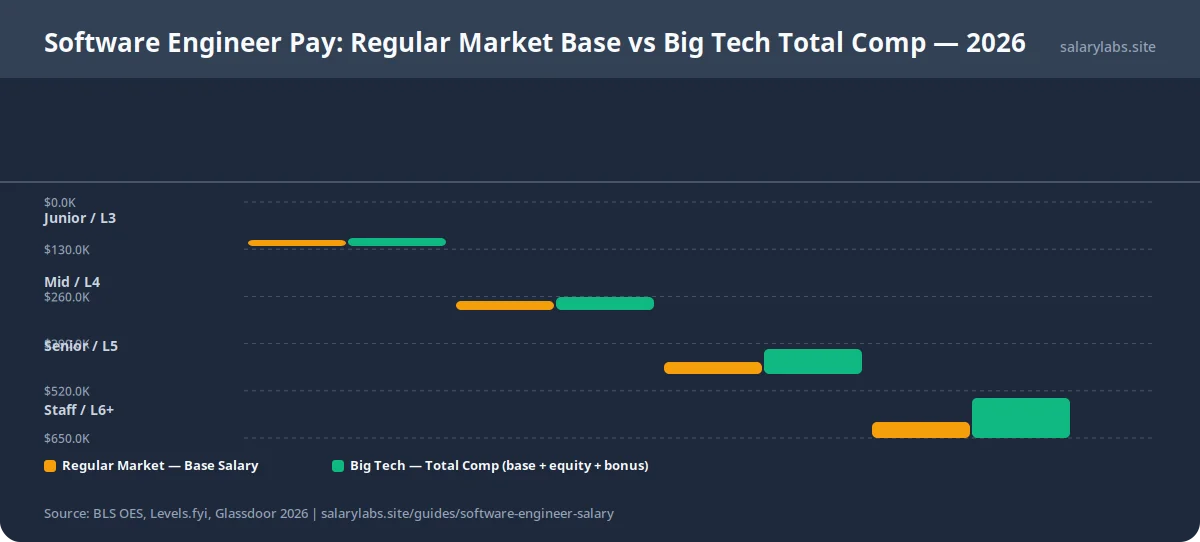
Software Engineer Pay: Regular Market Base vs Big Tech Total Comp — salarylabs.siteView data table
Software Engineer Pay: Regular Market Base vs Big Tech Total Comp — 2026
Category
Regular Market — Base Salary
Big Tech — Total Comp (base + equity + bonus)
Junior / L3
95000
130000
Mid / L4
140000
200000
Senior / L5
185000
380000
Staff / L6+
250000
600000
Salary by Experience Level (Base Only)
Start with base salary by level, then layer in city and company tier. That sequence is more useful than jumping straight to eye-catching total-comp numbers.
Level
Years Exp.
Base Salary Range
Median Base
Total Comp (Big Tech)
Junior / L3
0–3 yrs
$75K – $130K
$95,000
$150K – $220K
Mid-Level / L4
3–7 yrs
$110K – $175K
$140,000
$200K – $330K
Senior / L5
7–12 yrs
$150K – $230K
$185,000
$280K – $500K
Staff / L6
10–15 yrs
$200K – $320K
$250,000
$400K – $700K
Principal / L7+
15+ yrs
$280K – $450K+
$350,000
$600K – $1.5M+
* Base salary is a directional US market anchor. Big-tech total-comp ranges combine public wage context with editorial compensation-band estimates for 2026 planning, not live employer quotes.
Junior / L3
0–3 years
$95K
$75K – $130K base
Learning curve phase. Company and city matter more than title at this level.
Mid / L4
3–7 years
$140K
$110K – $175K base
Most job postings target this band. Scope ownership starts to move the number.
Cross-team impact required. RSU vesting becomes a large share of total comp.
What Actually Moves Software Engineer Pay
The biggest pricing differences usually come from role shape, not title cosmetics. Employers tend to pay more when the engineer is harder to replace in one of these ways:
Revenue or reliability exposure: teams tied to checkout flow, ads, infrastructure uptime, or security incidents usually price risk more aggressively.
Production complexity: distributed systems, high-scale backend work, and security engineering are expensive because mistakes are expensive.
Labor market scarcity: AI/ML and platform-heavy roles can command wider bands when the company is competing with top-end tech employers.
Banding policy: the same engineer can look “underpaid” or “well paid” depending on whether the employer uses regional bands, national remote bands, or stock-heavy ladders.
Salary by City (Mid-Level, Total Comp)
Raw comp alone can mislead. The table below is more useful when you read median total compensation alongside local cost pressure and real purchasing power.
City
Median Total Comp
Cost of Living Index
Real Value*
San Francisco, CA
$245,000
183
$134,000
Seattle, WA
$220,000
162
$136,000
New York, NY
$210,000
172
$122,000
Austin, TX
$170,000
123
$138,000
Raleigh, NC
$150,000
112
$134,000
Denver, CO
$165,000
128
$129,000
Chicago, IL
$160,000
118
$136,000
Remote (US)
$155,000
100 (avg)
$155,000
* Real value = total comp adjusted for cost of living vs national average (index 100). Remote work can provide stronger purchasing power in some scenarios, but not as a universal rule.
San Francisco
$245K
total comp · COL 183
Seattle
$220K
total comp · COL 162
New York
$210K
total comp · COL 172
Austin ★ best value
$170K
real value $138K · COL 123
Raleigh ★ best value
$150K
real value $134K · COL 112
Denver
$165K
total comp · COL 128
Chicago
$160K
total comp · COL 118
Remote (US)
$155K
avg COL 100 · purchasing power varies
Salary by Specialty (Senior Level)
★
AI / ML Engineering
$220K – $600K+ total comp
One of the strongest demand pockets in this guide. PyTorch, LLM fine-tuning, MLOps.
* Specialty ranges are editorial comparison bands built around public software-developer wage context and common private-market compensation patterns. Use them to compare role shape and ceiling, not as a quoted ladder for one company.
Are You Underpaid? Use the Market Benchmark
If your compensation is materially below the level, city, and company context that matches your role, it is worth investigating. The strongest signal is not one benchmark alone. It is a cluster of comparisons that all point in the same direction.
Are You Being Paid Fairly?
Check your salary against directional SWE market benchmarks
* The inline benchmark widget uses simplified guide medians by level. It is useful for early self-checking, not for determining whether a specific company is underpaying you.
Negotiation Tips for Software Engineers
Negotiate the package, not just the base: at larger employers, RSUs, signing bonus, and first-year refresh timing may move more than salary alone.
Price your scope clearly: frame the role in terms of production ownership, system complexity, and business risk, not just years of experience.
Use more than one benchmark: city, level, and company tier together are more persuasive than one compensation screenshot taken out of context.
Ask how the band works: remote pay policy, refresh cadence, and promo path often matter as much as the opening number.
Competing options help, but context also matters: a second offer is strong, but a well-scoped internal case can still move a package when the role is clearly under-banded.
The Benchmarking Rule
Title + level + city + company tier — all four, not just one.
A $130K offer sounds different depending on whether it is junior in San Francisco or senior in Raleigh.
The number only means something when you anchor it to all four dimensions at once.
Comp screenshots without context are the most common way engineers underprice themselves.
What is the average software engineer salary in the US in 2026?
Public wage anchors for software developers sit well below the highest private-market compensation numbers readers often see online. SalaryLabs uses public wage context plus directional company-tier and city comparisons because the title alone does not price the role well.
How much does a junior software engineer make?
Junior pay varies sharply by employer type and city. Entry-level startup, enterprise, and large-tech roles can all sit under the same title while offering very different cash, equity, and growth paths.
What city pays software engineers the most?
The Bay Area usually leads on gross compensation, but cost-adjusted value can look stronger in lower-cost markets or in well-banded remote roles. City tables make more sense when pay and cost pressure are read together.
What is the highest-paying software engineering specialty?
AI/ML, security, and distributed systems often command the highest premiums, but the key driver is usually production difficulty and business impact rather than the label alone.
Turn the market benchmarks above into your own numbers: compare your current pay to the range, or benchmark a job offer before you negotiate.
Compare your monthly salary against software engineering benchmarks across several major markets, then use the result as negotiation context rather than a single-source verdict.
Software engineering pay changes fast by city, company tier, specialty, and equity mix. Use this closing set to validate the benchmark and prepare a cleaner compensation conversation.
Turn the benchmark into a more decision-ready pay check
If this guide makes your current pay look weak or unusually strong, run the internal follow-up path first: estimate take-home pay, then see where that income sits nationally before you treat the benchmark as a negotiation anchor.
Data & Methodology: This guide uses public software-developer wage context as an anchor, then layers on directional city, company-tier, and specialty comparisons. Use the page to frame engineering pay bands and negotiation context, not as a live quote for any one employer. Methodology