
How to Negotiate Salary After Receiving a Job Offer

Receiving a job offer feels like the end of the process. It is actually the beginning of the most important conversation in your hiring process — the one where you decide what you are actually worth. Most candidates accept the first number. Candidates who prepare earn 10-20% more over the next two years. This guide gives you the framework, the data, and the exact words to use.
Should You Negotiate?
The short answer is almost always yes — with one condition. Negotiation is appropriate when you are professional, data-backed, and genuine in your interest. It is not appropriate when you are threatening to walk, lying about competing offers, or treating the process as adversarial.
Use this checklist to decide whether to negotiate your current offer:
Research Market Salary
Negotiation without data is negotiation without ammunition. Before you say anything to a recruiter or hiring manager, you need to know what someone in your role, at your experience level, in your location, is actually worth.
What to research
- Base salary range for your role and level in your specific metro or remote context
- Total compensation including bonus, equity, and signing bonus — not just base
- Company stage and funding — Series B startups and Fortune 500 companies negotiate very differently
- Cost of living in the offer's location — a $90K offer in Austin is different from $90K in San Francisco
Where to find the data
- SalaryLabs profession guides — See your specific field:
- BLS Occupational Employment Statistics —bls.gov/oes — nationally representative wage data updated annually
- Levels.fyi — tech-specific total compensation for engineers at large companies
- Glassdoor, Indeed, LinkedIn Salary — good for location-adjusted ranges at smaller companies
- Bureau of Labor Statistics FRED — wage growth trends over time
Location matters enormously. The same software engineer role pays $130K-$160K in Austin and $170K-$220K in San Francisco.BLS OEWS (May 2024 (most recent available as of 2026-07; May 2025 release tracked separately))verified 2026-07-31 The same teacher role pays $55K in Tennessee and $85K in New York.BLS OEWS (May 2024 (most recent available as of 2026-07; May 2025 release tracked separately))verified 2026-07-31 Do not compare offers in different metros without adjusting for cost of living.See the Cost of Living by State guide →
Know Your Take-Home Pay
The number on the offer letter is not what hits your bank account. Federal tax, FICA, state income tax, health insurance premiums, and retirement contributions can reduce a $100,000 gross offer by $25,000-$38,000 depending on your state and deductions. Negotiate in net — or at least be honest with yourself about the gap.
A $5,000 signing bonus that you receive as a lump sum is worth more than a $5,000 base salary increase that gets taxed every paycheck. Use the tools below to run the real numbers before you counter.
How Much Should You Ask For?
Never counter with a single number. Counter with a range — and give yourself three numbers before the conversation starts.
The formula
A reliable approach: take their offer, add 10-15%, and use that as your opening counter. If they offer $90,000, counter at $103,500-$105,000.
For senior or specialized roles with strong market data: counter at the top of the market range plus 5-10%. If your research shows $95K-$125K for your level, open at $130,000-$135,000.
If benefits are negotiable (more on that below), consider trading: accept their salary ceiling in exchange for an extra week of PTO or a higher 401(k) match.
The Negotiation Framework
The structure below is not a script — it is a sequence. Each step builds on the last. Follow it in order and keep every communication professional and warm.
"Thank you so much for this offer. I am genuinely excited about the role and the team. I want to take a couple of days to review the details, if that works for you, and then I would love to discuss a few aspects of the compensation package."
Why: This buys you time and signals engagement without hostility.
"I want you to know that I am very interested in this role. The work on [specific project] and the team structure is exactly what I am looking for."
Why: Employers negotiate harder for candidates they believe will accept. Make them believe you want the job — then give them a reason to improve the offer.
"Based on my research into comparable salaries for this role at this level in [location], the market range appears to be [X–Y]. Based on my experience with [specific skills or credentials], I was hoping we could discuss moving closer to [$Z]."
Why: This is the moment you show your number is not arbitrary. You are correcting a market information gap, not making demands.
"I was hoping we could find a number in the [$115,000–$125,000] range. I am flexible on the exact number if we can find something that works for both of us."
Why: A range prevents the employer from accepting your single number as a new ceiling. It signals flexibility while protecting your target.
After you make your counter, stop talking. Let the employer respond. Silence is not awkward — it is leverage. If they say they need to discuss internally, let them.
Most candidates fill silence with nervous concessions. Do not. "I appreciate you taking the time to review this" is a complete sentence after you have made your ask.
Why: The employer who needs time to think is the employer who is seriously considering your counter. Fast acceptance usually means you left money on the table.
Example Scripts by Profession
The negotiation framework above applies to every profession. What changes is the market data framing — what you cite as your evidence. Here are profession-specific examples:
Senior Software Engineer, remote or major metro
"Based on market data from Levels.fyi and comparable offers I have seen for senior engineers in [Austin/Denver/Boston], the range for this role appears to be $140K–$170K. Given my experience with [distributed systems / ML pipelines / platform architecture], I would like to discuss whether $155,000 is achievable."
"I want to be direct: I am very interested in the role. My goal is to reach $155K. If we cannot get there on base, I am open to discussing a higher signing bonus or equity front-loading to bridge the gap."
Certified Teacher, public school district
"I am very grateful for this offer and I am excited to join. Before I accept, I wanted to ask whether the salary schedule has any flexibility for my [years of prior experience / National Board certification / subject-area specialization]."
"Based on the Step 5 lane I was placed on, I wanted to ask whether Step 6 or placement at the MA+30 lane would be possible given my graduate credits in [content area]."
Registered Nurse, hospital system
"Thank you for this offer. I want to say first that I am genuinely excited about this unit — the team and the work align with exactly what I am looking for."
"Before I accept, I wanted to ask whether there is flexibility in the offer for my [two years of ICU experience / BSN degree / specialty certification]. I have also received a competing offer and I want to be transparent about that — I prefer your hospital, but the compensation gap is significant enough that I need to ask if there is room to adjust."
Project Manager, mid-market or enterprise
"Thank you for this offer. I am genuinely interested and want to move forward. Before I do, I wanted to discuss the compensation, if there is room to revisit the number."
"Based on my research into PM salaries at this seniority level in [industry], I have seen ranges of $90K–$115K. With my [PMP / experience managing $X programs / specific industry background], I was hoping we could discuss $100,000. Is there flexibility there?"
Five Mistakes That Kill Negotiations
Knowing what not to do is as important as knowing what to say. These five moves will damage your negotiating position faster than anything else.
Lying about competing offers is the fastest way to destroy trust. If you do have competing offers, you do not need to lie — you can say "I am in final stages with another organization and want to be transparent about that timeline." Employers respect honesty, not threats.
Never lead with your needs. Leads with needs signal that your number is arbitrary. Leads with market data signal that your number is defensible. "My research shows the market range is $X" is not a want — it is a fact. "I need $X because of my bills" is a want.
Unless you genuinely mean it, never make ultimatums before you have exhausted the conversation. "I am not going below $105,000" before you have heard the employer's full reasoning is leaving value on the table. You may discover they can offer a signing bonus, equity, or PTO you had not considered.
The best salary negotiations happen on the phone or in person. Email strips away tone, warmth, and the ability to read the room. It also creates a paper trail that can complicate the process. Request a 15-minute call. "I have a few questions about the offer — could we connect by phone?" is all you need.
Once you have signed or verbally accepted an offer, the negotiation is closed. Attempting to reopen compensation after acceptance signals bad faith and can result in the offer being withdrawn. Negotiate before you accept. Once you say yes — commit.
Remote Jobs: A Different Strategy
Remote roles change the negotiation calculus in two important ways.
Geographic pricing
Many companies still apply location-based salary bands to remote roles — paying someone in rural Montana less than someone in San Francisco for the same work. If a company offers you a "San Francisco-level" role on a "Montana-level" salary because you live in Montana, push back.
The argument: "If my work is evaluated at the same standard as a San Francisco employee, my compensation should align with that standard, not my zip code." This is increasingly accepted by companies with explicit location-agnostic pay policies — and increasingly resisted by companies that have not updated their compensation philosophy.
Home office and equipment
Remote roles often include one-time setup stipends or equipment loans. If the offer does not include one, ask: "Does the company provide home office equipment or a setup stipend for remote employees? If not, is there room to add one?" A $1,500 home office setup is worth more than a $1,500 salary bump — it is untaxed.
Benefits Matter as Much as Base Salary
When the employer says they cannot move on base salary, the conversation is not over. Benefits are compensation — and they are often more negotiable than base.
A 4% employer match on $100K is $4,000/year. Some companies will increase their match for strong candidates even when base cannot move. "I noticed the plan has a 3% match — would it be possible to increase that to 5% as part of this offer?" is a reasonable ask.
See retirement contribution guide →Employer health plan contributions can range from $0 to $10,000+/year for family coverage. If the employer pays 100% of employee premiums, that is a tangible dollar value. Ask what the employer contribution covers — employee only, or dependents too?
See healthcare premium impact →A signing bonus is paid as a lump sum, usually taxed as supplemental income in the year received. It is still worth negotiating — $7,500 as a signing bonus hits your account all at once. A $7,500 base increase gets divided across 24 paychecks and subject to ongoing taxation.
At startups or public companies, equity is the most leverageable part of total comp. A higher strike price, more options, or larger RSU grant can be worth hundreds of thousands over a four-year vest. Ask for the full equity refresher schedule and negotiate grant size before you accept.
An extra week of PTO is worth $1,900-$3,800 in value (your hourly rate × 40-80 hours). If base cannot move, PTO is one of the most valuable benefits to negotiate. "I am flexible on the compensation, but an additional week of PTO would make this offer work for me" is a complete counter.
Tuition reimbursement, conference budgets, certification bonuses, and training stipends are often unadvertised budget lines that managers can allocate. $5,000/year in tuition reimbursement over four years is $20,000 of value you did not have before.
When Not to Negotiate
Negotiation is a skill, but it is also a judgment call. There are legitimate situations where you should accept the offer as-is and move forward.
- The offer is above your market research. If they offered you more than you expected and the benefits package is solid, accept. There is no prize for leaving money unclaimed.
- The role has a hard salary band. Government jobs, academic positions with published scales, and union-represented roles often have zero flexibility on base. Attempting to negotiate these is awkward and can signal you have not done your homework.
- The timeline is compressed for a reason. If the employer has communicated a genuine deadline and you need the job, do not blow the deadline over $3,000. Take the offer and revisit at your 90-day review.
- You have already negotiated once. One round of negotiation is professional. Reopening the conversation after you have agreed is not.
- The total compensation is genuinely strong. A lower base with a higher bonus, equity, and better benefits can be worth more than a higher base. Evaluate the whole package, not just the headline salary.
Salary Calculators to Finish the Math
Before you counter, run the numbers. These tools give you the data foundation for a professional, data-backed negotiation.
Frequently Asked Questions
Should you always negotiate your first job offer?
Does negotiating risk the employer rescinding the offer?
What if I have no competing offers?
Should I negotiate remote work or benefits instead of salary?
How do I negotiate a counteroffer from my current employer differently?
What should I say when they ask about my salary expectations?
This guide is a general salary negotiation framework and does not constitute legal, financial, or career advice. Individual negotiation outcomes depend on role, industry, employer, location, and market conditions. All salary data cited is directional and sourced from publicly available BLS, BEA, and employer compensation surveys.See full methodology →
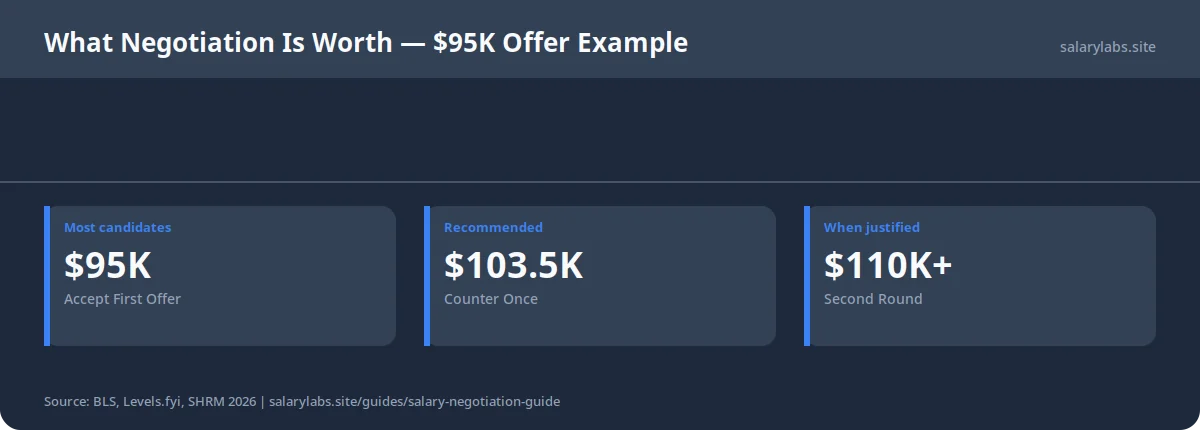
View data table
| Badge | Value | Label |
|---|---|---|
| Most candidates | $95K | Accept First Offer |
| Recommended | $103.5K | Counter Once |
| When justified | $110K+ | Second Round |