
Self-Employment Tax 2026: The 1099 vs W-2 Take-Home Reality

"Just charge 15% more as a 1099 and you'll come out the same." It is the somewhat rule of thumb that survives a coffee conversation but not a tax return. Self-employment tax is 15.3%, but only half of it is deductible. Health insurance moves from a payroll item to a market premium. Retirement contributions change shape. Quarterly estimated taxes replace smooth withholding. This guide walks the math at four income levels — $50,000, $80,000, $120,000, and $200,000 — and shows where 1099 is structurally favorable, where W-2 wins, and what the headline rate-up rule actually needs to be.
Source data: 2026 IRS Schedule SE rates, the 2026 Social Security wage base of $184,500, published 2026 federal income tax brackets, and SBA / IRS retirement plan limits. Citations are inline and at the end of the guide.
What this guide is. A structural comparison of 1099 self-employed and W-2 employee take-home math at four income levels, accounting for self-employment tax, the above-the-line SE deduction, health insurance differential, retirement contribution room, and quarterly cash flow. What it is not. A career recommendation, a tax planning service, or a substitute for advice from a CPA on your specific situation.
The Formal Math: SE Tax vs FICA
The W-2 employee and the 1099 contractor pay the same Social Security and Medicare programs, but through different mechanics that produce different out-of-pocket totals.
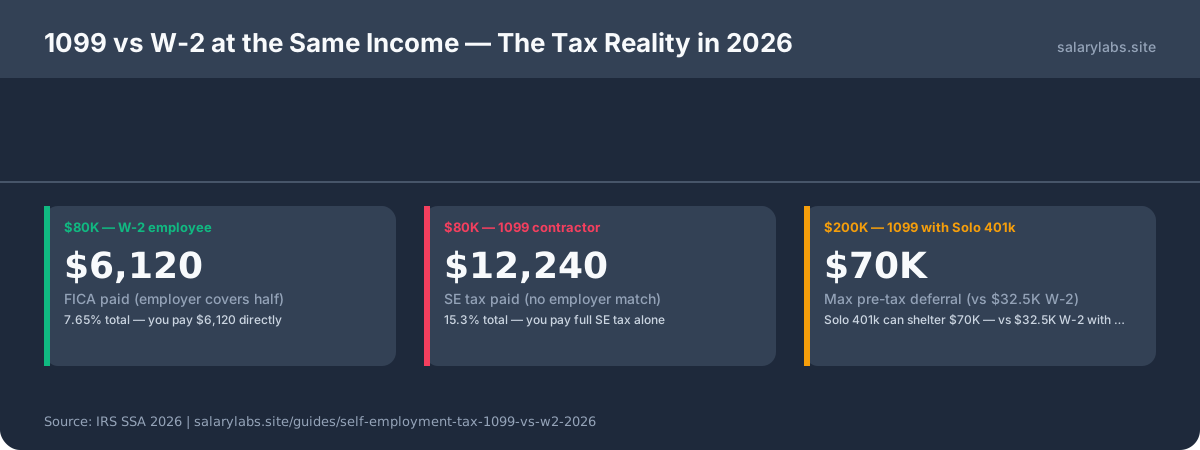
W-2 FICA. The employee pays 7.65% of gross wages — 6.2% Social Security on earnings up to the 2026 wage base of $184,500, plus 1.45% Medicare on all earnings. The employer pays a matching 7.65%. The employee never sees the employer half on the paycheck; it is part of the cost of employing the worker but not part of stated salary.
1099 self-employment tax. The contractor pays both halves. The rate is 15.3% applied to net self-employment earnings multiplied by 0.9235 — the multiplier mathematically equates the SE tax base with the W-2 case where employer FICA is excluded from wages. The 15.3% breaks down as 12.4% Social Security up to the wage base and 2.9% Medicare on all earnings. An Additional Medicare Tax of 0.9% applies above $200,000 single / $250,000 joint, on the portion above the threshold.
The above-the-line deduction. Critically, the contractor deducts half of total self-employment tax on Form 1040 Schedule 1. This reduces adjusted gross income, which reduces both federal and most state income tax. The deduction is not optional and not itemized — it applies to every Schedule SE filer. Without accounting for it, every 1099 vs W-2 comparison overstates the SE tax burden.
Why Naive Comparison Misleads
Two rules of thumb circulate in freelance circles. Both are wrong in opposite directions.
Rule one: "Add 7.65% to the W-2 salary to get the equivalent 1099 rate." This adds back the employer FICA the W-2 employee does not see. It is structurally incomplete — it ignores the SE tax deduction, which recovers about 22-24% of the additional 7.65% at typical brackets. The honest gross-up is closer to 5-6%, not 7.65%, when paying out of W-2-equivalent income at middle brackets.
Rule two: "Take 15.3% off the 1099 income to compare to W-2." This double counts the employee FICA already implicit in the W-2 case and again ignores the deduction. It overstates the wedge by roughly 4-5 percentage points. Contractors who use this rule systematically undercharge or overestimate the burden.
The cleanest comparison: model both cases through the actual federal income tax stack with SE tax and SE deduction applied, and add health insurance and retirement contribution differentials separately. The next sections do exactly that.
Worked Example: $80,000 Nominal Income, Single Filer
The middle income case is where the SE tax wedge matters most because retirement contributions and business deductions cannot offset enough.
| Item | W-2 employee | 1099 contractor |
|---|---|---|
| Gross / net SE earnings | $80,000 | $80,000 |
| Self-employment tax (15.3% × 0.9235) | — | $11,304 |
| FICA (employee share) | $6,120 | — |
| Half SE tax deduction | — | −$5,652 |
| Adjusted gross income | $80,000 | $74,348 |
| Standard deduction | −$15,000 | −$15,000 |
| Taxable income | $65,000 | $59,348 |
| Federal income tax (2026 brackets) | ~$9,214 | ~$7,970 |
| State income tax (illustrative ~5%) | ~$3,000 | ~$2,720 |
| After-tax annual | $61,666 | $58,006 |
| Visible federal wedge | ≈ $3,660 in favor of W-2 | |
Reading: at $80,000 nominal, the 1099 contractor pays roughly $5,200 more in SE tax than the W-2 employee pays in FICA, but the SE deduction and reduced taxable income claw back about $1,500 in federal tax. Net visible wedge is approximately $3,660 per year. State tax treatment varies — the SE deduction reduces state taxable income in conformity states but not in California or a handful of others.
That is before the hidden wedges, which are larger than the visible one for most contractors at this income level.
The Hidden Wedges
The visible federal wedge is the easy part of the comparison. Three larger structural items reshape the picture, and most rule-of-thumb gross-ups ignore them.
ACA marketplace premiums vs employer-subsidized coverage. A W-2 employee with employer health insurance typically pays $200-$400 per month for individual coverage, with the employer absorbing the larger share. A 1099 contractor purchasing an individual ACA marketplace silver plan typically pays $500-$800 per month for individual coverage, with subsidies that phase out as income rises. The annual differential at middle income runs $3,600-$4,800. Family coverage opens a substantially wider gap.
Retirement contribution room and employer match. A W-2 employee with a 401(k) match (typical structure: 100% on first 3-4% of salary) gets meaningful free contributions on top of personal deferrals. A 1099 contractor has no match — but has access to a Solo 401(k), which in 2026 permits up to $24,500 elective deferral plus 25% of net self-employment earnings as employer-side contribution, subject to a $72,000 combined cap ($80,000 with the standard age 50+ catch-up). The ceiling is dramatically higher than the W-2 401(k) limit ($24,500 elective without employer match), but it requires the contractor to actually fund both sides.
Paid time off, sick leave, and unemployment insurance. A W-2 employee with three weeks of PTO captures roughly $4,600 of paid non-working time at a $80,000 salary. A 1099 contractor takes time off without pay. State unemployment insurance covers W-2 separations; 1099 separations generally do not qualify. These are not tax items, but they affect total compensation comparison materially.
Combined hidden wedge at $80,000 nominal: typically $6,000-$10,000 per year, depending on health plan choice and PTO usage. Adding to the $3,660 visible federal wedge produces a total gap of $9,500-$13,500 — meaningfully larger than the rate-up rule of thumb suggests.
Worked Example: $200,000 Nominal Income, Single Filer
At higher income, two structural shifts change the calculus. The Social Security portion of SE tax caps at the wage base, and Solo 401(k) contributions become large enough to dwarf the SE tax wedge.
| Item | W-2 employee | 1099 contractor |
|---|---|---|
| Gross / net SE earnings | $200,000 | $200,000 |
| SE tax: SS portion ($184,500 cap) | — | $22,878 |
| SE tax: Medicare 2.9% × ($184,700) | — | $5,356 |
| FICA: SS 6.2% × $184,500 | $11,439 | — |
| FICA: Medicare 1.45% × $200,000 | $2,900 | — |
| Total payroll / SE tax | $14,339 | $28,234 |
| Half SE deduction | — | −$14,117 |
| Visible payroll wedge before deduction | $13,895 in favor of W-2 | |
| Federal tax saved by SE deduction (24% bracket) | — | ~$3,388 |
| Net visible wedge | ≈ $10,500 in favor of W-2 | |
Reading: at $200,000, the SE tax SS portion caps because earnings exceed the wage base, so the marginal extra dollar of self-employment income above $184,700 is taxed at 2.9% Medicare rather than 15.3%. The wedge gets smaller in marginal terms past the cap. Below the cap, it is the same 6.48 percentage point gap as at $80,000.
The retirement picture is where the 1099 case actually catches up at this income level. The W-2 employee with a 4% match defers $24,500 personal plus $8,000 match = $32,500. The 1099 contractor with a Solo 401(k) defers up to $24,500 elective plus 25% of net SE earnings (~$36,925 employer-side, capped to $47,500 to stay under the $72,000 combined limit). Total deferral can reach $72,000 — more than double the W-2 case. At a 24% marginal rate, the additional ~$38,500 of pre-tax deferral saves roughly $9,200 in current-year federal tax.
That single difference — Solo 401(k) ceiling vs employer-plan cap — closes much of the visible wedge for a contractor who actually contributes. The unfunded contractor sees only the SE tax burden and concludes 1099 is structurally bad. The disciplined contractor sees the deferral room and concludes 1099 is structurally good. Both observations reflect the same tax code; the discriminator is contribution behavior.
Quarterly Estimated Tax Cash Flow
The cash flow shape is different even when the totals look comparable. The W-2 employee sees federal tax, FICA, and state tax withheld each pay period — 24 to 26 deductions per year, smoothed by payroll. The 1099 contractor receives gross payments and is responsible for sending the IRS estimated taxes four times per year: April 15, June 15, September 15, and January 15 of the following year, plus the annual return on April 15.
The amounts are not trivial. A contractor netting $80,000 owes roughly $19,000 in combined federal income tax and SE tax, paid in four installments of approximately $4,750 each. State tax adds $2,500-$5,000 depending on jurisdiction, often paid on a parallel quarterly schedule. Cash management discipline matters: a contractor who spends gross receipts and lacks reserves at the April or June deadline triggers underpayment penalties.
Safe harbor. The IRS waives the underpayment penalty if total estimated payments and withholding meet the lesser of 90% of current-year tax or 100% of prior-year tax (110% if prior-year AGI exceeded $150,000). Many contractors set quarterly payments using the prior-year safe harbor and reconcile any shortfall on the April return. This shifts cash management complexity away from forecasting current-year income, which is especially useful for contractors with variable monthly receipts.
Practical pattern. Move 25-30% of every gross payment into a separate tax-reserve account on receipt. Pay quarterly from that account. The discipline beats every tax software forecast for new contractors who do not yet have a stable revenue baseline.
+ prior year return
(following year)
When the 1099 Case Is Structurally Favored
The math points to several profiles where 1099 produces meaningfully better economic outcomes than W-2 for the same nominal pay.
- High income with disciplined retirement deferral. Solo 401(k) ceiling of $72,000 (or $80,000 with the catch-up at age 50+) dwarfs the W-2 401(k) cap. At $200,000+ income, the deferral advantage on its own can exceed $30,000 per year of additional pre-tax savings, which compounds across a career.
- Real, substantial business deductions. Home office (calculated by square-footage method or simplified method), business-use mileage at the 2026 IRS rate, equipment depreciation under §179, professional development, and percentage of phone / internet attributable to business reduce SE earnings before SE tax applies. A contractor with $15,000-$25,000 of legitimate deductions reduces SE tax base by 1.4-2.3 percentage points of gross.
- Schedule control with measurable value. Contractors who can take unscheduled vacation, accept higher-paying short engagements, or refuse work without HR process capture flexibility value that does not appear in tax math but is real income to the household.
- Geographic and client diversification. A contractor working with three to five clients spreads single-client risk that the W-2 employee bears against one employer. The diversification value increases with income and skill specialization.
When the W-2 Case Is Structurally Favored
- Below approximately $80,000 nominal. SE tax wedge plus health insurance differential plus lost PTO routinely exceeds $10,000 per year. The flexibility benefit rarely values that high for early-career or middle-income contractors. The W-2 case is structurally cleaner unless the contractor specifically needs the schedule control.
- Variable monthly receipts without reserve discipline. Contractors who spend gross payments and miss quarterly estimated deadlines accumulate penalties and interest that erode the rate-up advantage. The W-2 withholding mechanism prevents the cash management failure mode entirely.
- Strong employer benefits package. A W-2 role with employer-paid health insurance, generous 401(k) match (5%+), defined benefit pension residual, employer-paid professional development, and substantial PTO captures effective compensation that a 1099 rate-up of 30-40% does not always replicate.
- Need for unemployment insurance coverage. Workers in cyclical industries or with limited savings benefit materially from the unemployment insurance backstop the W-2 structure provides. The 1099 alternative is self-funded reserves, which most workers do not maintain at the equivalent level.
The Honest Rate-Up Rule
A 1099 contractor moving from a W-2 role at $80,000 needs to charge a billing rate that produces approximately $95,000-$105,000 of net SE earnings to match W-2 take-home plus benefits. That is a 19-31% gross-up over the W-2 salary, varying with health plan choice, retirement contribution behavior, and PTO valuation.
The headline rules of thumb (15.3% or 7.65% gross-up) systematically undershoot the real replacement rate at middle income, where hidden wedges dominate. At $200,000+ income with disciplined Solo 401(k) contributions, the required gross-up shrinks to 10-15% because the retirement deferral advantage offsets a meaningful portion of the SE tax burden.
Limitations
- State variation. States vary in how they treat the SE tax deduction for state income tax purposes. Most conformity states allow it; California and a few others do not. State income tax bracket structure also affects the marginal benefit of pre-tax retirement contributions.
- Healthcare market volatility. ACA marketplace premiums and subsidy thresholds change annually. The premium differential used in this guide reflects 2026 averages and varies substantially by state, age, and plan tier. Spouse-of-W-2-employee coverage can eliminate the health insurance wedge entirely for the 1099 contractor.
- Retirement contribution limit changes. The IRS adjusts elective deferral limits, catch-up contributions, and combined plan caps in most years. The 2026 figures used here are current at publication; long-term planning must use updated limits.
- Self-discipline requirement. The 1099 advantage at higher income requires actually funding the Solo 401(k), actually paying quarterly estimated taxes on time, and actually maintaining tax-reserve discipline. Contractors who do not execute these behaviors capture less of the structural advantage.
- Tax law changes. The 2017 Tax Cuts and Jobs Act provisions affecting pass-through deduction (QBI 20% deduction for qualifying self-employment income) are scheduled to sunset in 2026 unless extended. The QBI deduction can shift the comparison meaningfully for contractors operating below the income phase-out thresholds.
Run the Numbers on Your Situation
Related Guides
- What is FICA Tax — the 7.65% employee / 15.3% self-employed structure explained
- When Hourly Beats Salary — the comparable decision framework for hourly vs salaried W-2 work
- Take-Home Pay Calculation — the line-by-line formula explanation
- No-Tax State Math, Honestly — state-level tax structure for the location dimension
- Federal Tax Brackets 2026 — bracket structure that applies to both W-2 and 1099 income
- Backdoor Roth IRA Calculator — if you have a SEP-IRA balance from prior self-employment years, the §408(d)(2) pro-rata rule applies to any backdoor Roth conversion. Calculator #16 runs the full Form 8606 line-by-line and shows the cleanout strategy.
Sources
How the 1099 vs W-2 comparison is computed
SE tax = net SE earnings × 0.9235 × 15.3%. Half of SE tax is deductible on Form 1040 Schedule 1. Take-home = gross − SE tax − income tax. The QBI deduction (up to 20% of taxable income) is available to many self-employed filers and reduces the effective tax rate further.
Federal income tax uses 2026 IRS brackets for the filing status shown. SE tax rate is 12.4% Social Security on earnings up to the 2026 wage base of $184,500 plus 2.9% Medicare on all earnings. Worked examples use a 5% illustrative state tax. ACA premium ranges reflect 2025 Kaiser Family Foundation Employer Health Benefits Survey data.
IRS Schedule SE (Pub. 1040-SSE); IRS Rev. Proc. 2025-32 (federal brackets); SSA Contribution and Benefit Base 2026; KFF 2025 Employer Health Benefits Survey.
Single filer, standard deduction, no dependents, no itemized deductions, no QBI deduction applied in the visible wedge calculation unless noted. State income tax uses an illustrative 5% rate; actual state treatment varies.
Self-employment tax rates are statutory and do not change. Income tax calculations depend on filing status, deductions, and credits not shown here. ACA premiums vary sharply by age, income, plan metal tier, and geography. The worked examples are illustrative — individual results will differ.
- IRS Schedule SE (Form 1040) instructions: irs.gov Schedule SE
- IRS Self-Employment Tax overview: IRS Self-Employment Tax
- IRS Retirement Plans for Self-Employed: IRS Small Business Retirement Plans
- Social Security Wage Base 2026: SSA Contribution and Benefit Base
- Health Insurance Marketplace: HealthCare.gov
- IRS Estimated Taxes (Form 1040-ES): IRS Estimated Taxes
- Tax Estimator
- Salary Calculator