
How Overtime Pay Works in the United States

Overtime pay is one of the most important — and most misunderstood — aspects of US employment law. Millions of American workers either don't know they're entitled to overtime, or don't realize their employer may be miscalculating or withholding it. This guide explains how overtime works, who qualifies, how to calculate it, and what your rights are.
Use this guide when: you need to understand whether extra hours should be paid, what counts in the regular rate, or how state rules can beat the federal minimum. Do not use it as legal advice: overtime claims turn on job duties, time records, and state law details that this page cannot individually verify.
The Federal Overtime Rule: FLSA Basics
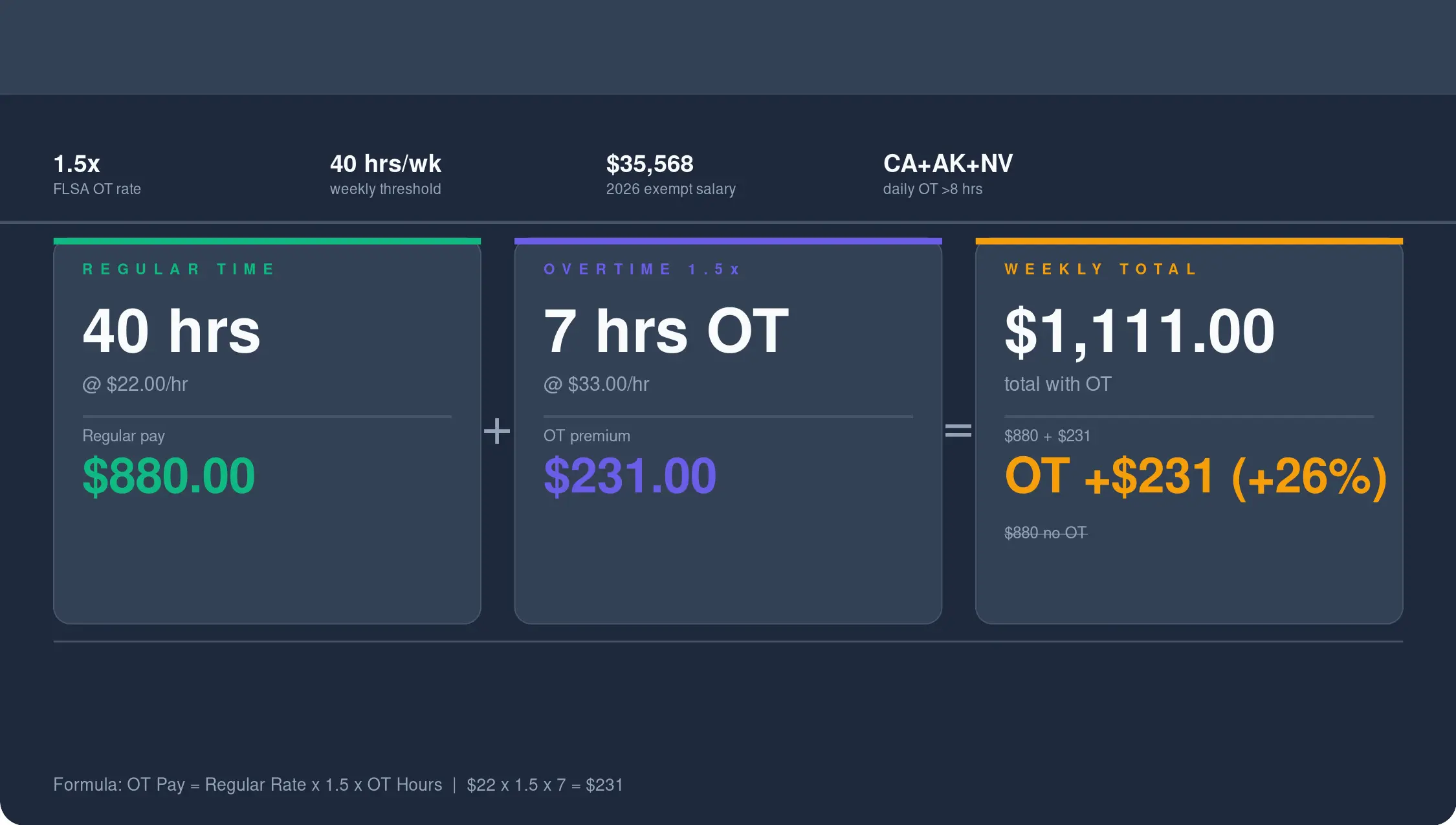
The Fair Labor Standards Act (FLSA) is the federal law governing overtime in the US. It requires that all covered, non-exempt employees receive overtime pay at a rate of at least 1.5 times (time-and-a-half) their regular rate for all hours worked beyond 40 in a single workweek.
Example: $22/hr regular rate → Overtime rate: $33/hr
A workweek under the FLSA is any fixed, regularly recurring 168-hour period (7 consecutive 24-hour days). Your employer sets the workweek — it doesn't have to align with the calendar week. Hours cannot be averaged across multiple weeks.
Who Qualifies for Overtime Pay?
Non-Exempt Employees (Eligible for Overtime)
Most hourly workers in the United States are automatically non-exempt and entitled to overtime protections. Non-exempt employees must receive 1.5× overtime whenever they exceed 40 hours in a workweek.
Exempt Employees (NOT Eligible for Overtime)
Employees are exempt from FLSA overtime requirements only if they meet both of these conditions:
- Salary threshold: Meet the current federal salary-basis threshold used in DOL exemption guidance
- Duties test: Primarily perform executive, administrative, professional, computer, or outside sales work
The highly compensated employee exemption applies to workers earning at least $107,432/year who perform at least one exempt duty. These workers are also exempt from overtime.
Misclassification warning: Employers sometimes incorrectly classify hourly or lower-paid salaried workers as "exempt" to avoid overtime obligations. If you regularly work more than 40 hours per week without overtime pay and your salary or duties do not satisfy the current federal exemption tests, you may be misclassified. The DOL's Wage and Hour Division investigates these claims.
- Most hourly workers
- Salaried below $35,568/yr threshold
- Jobs that don't pass the duties test
- Must receive 1.5× for hours over 40
- Salary ≥ $35,568/yr AND passes duties test
- Executive, admin, professional roles
- Computer employees (specific duties)
- Outside sales employees
- Highly compensated ≥ $107,432/yr
Regular Rate of Pay: What It Includes
Overtime must be calculated on your regular rate of pay, which may be higher than your base hourly rate — use our Overtime Calculator to compute yours in one view if you receive other forms of compensation:
- Non-discretionary bonuses (production bonuses, attendance bonuses)
- Shift differentials and premiums
- On-call pay
- Commissions (in some circumstances)
Excluded from the regular rate: Discretionary bonuses, gifts, vacation/holiday pay, overtime premiums, and employer contributions to benefit plans.
State Overtime Laws: Stricter Than Federal
The FLSA sets the federal minimum standard. States can — and many do — provide stronger overtime protections. If both federal and state law apply, the more favorable law for the employee takes effect.
- California: Daily overtime at 1.5× after 8 hours/day; 2× after 12 hours/day; 1.5× for the first 8 hours on the 7th consecutive day of the workweek; 2× after 8 hours on the 7th consecutive day
- Alaska: Daily overtime at 1.5× after 8 hours/day AND weekly after 40 hours/week
- Nevada: Daily overtime at 1.5× after 8 hours/day for employees earning less than 1.5× the state minimum wage
- Colorado: Overtime after 12 hours/day or 12 consecutive hours of work, in addition to weekly overtime
How to Calculate Overtime: Examples
Example 1 — Straight Hourly
Maria earns $18/hour and works 47 hours in a week. Regular pay: $18 × 40 = $720. Overtime pay: $18 × 1.5 × 7 = $189. Total weekly pay: $909.
Example 2 — With a Non-Discretionary Bonus
James earns $20/hour and worked 45 hours. He also earned a $100 production bonus this week. Regular rate = ($20 × 45 + $100) ÷ 45 = $22.22/hour. Overtime premium = $22.22 × 0.5 × 5 = $55.55. Total: ($20 × 45) + $100 + $55.55 = $1,055.55.
Example 3 — California Daily Overtime
Sofia in California works 5 days: Mon–Thu 10 hours each, Fri 5 hours = 45 total hours. Daily overtime applies: each day beyond 8 hours triggers 1.5×. Mon–Thu: 8 regular + 2 OT each day. Weekly overtime: 45 – 40 = 5 OT hours (but daily OT already covers most of these — California uses the more favorable calculation).
Use the Overtime Calculator to calculate your weekly and annual overtime earnings in one view at any rate and hours combination.
Can My Employer Give Comp Time Instead of Overtime Pay?
Private sector employers cannot substitute "comp time" for overtime pay under the FLSA. If you're a non-exempt private-sector employee who works 45 hours this week, your employer must pay you for 5 overtime hours — they cannot instead give you 5 hours off next week.
Exception: State and local government employers (not federal) may offer comp time in lieu of overtime pay to their employees, subject to FLSA rules and collective bargaining agreements.
What to Do If You're Not Getting Paid Overtime
- Document everything: Keep personal records of your hours worked, even if your employer doesn't require timesheets. Screenshot time-tracking apps, save email timestamps, log start/end times daily.
- Calculate what you're owed: Multiply unpaid overtime hours by your regular rate × 1.5. Under the FLSA you can recover up to 2 years of back pay (3 years for willful violations), plus an equal amount in liquidated damages.
- File a complaint: Contact the Wage and Hour Division of the US Department of Labor at dol.gov/agencies/whd or call 1-866-4-USWAGE. Complaints are confidential and retaliation by your employer is illegal.
- Consult an employment attorney: Many employment attorneys handle wage theft cases on contingency (no upfront cost). The FLSA allows you to recover attorney's fees if you win.
What this guide cannot settle on its own: exempt-status disputes, collective-bargaining exceptions, and state-specific edge cases often need the job description, pay records, and workweek setup. Use this page to frame the issue. Then escalate it through the right channel.
Overtime Pay & FLSA Questions
Overtime Calculators & Guides
Overtime decisions are clearest when you price both the legal pay rule and the hidden cost of long weeks. Use these tools to compare both sides before you negotiate or escalate.
Related: Overtime rules and minimum wage laws work together. Check Minimum Wage by State 2026 for your state's base rate, or Average Salary by State to benchmark your total compensation against regional norms.