
Real Take-Home Pay in Every US State, 2026

An $80,000 offer in San Francisco does not buy what an $80,000 offer in Knoxville buys. Most take-home calculators stop at federal tax, FICA, and state income tax, then leave the harder part of the comparison to the reader. This guide finishes the math: it stacks taxes and cost of living so the result is one comparable number per state, not three separate snapshots.
New to take-home pay comparisons? Start here:
- "Real take-home pay" means: how much money you actually keep after taxes, adjusted for how expensive life is where you live.
- Cost of living matters because $80,000 goes further in Mississippi than in California — the same dollar buys more groceries, rent, and gas.
- The formula: (Gross salary − all taxes) ÷ cost-of-living index × 100 = real purchasing power. Higher = better.
The dataset behind this page uses the Take-Home Pay Calculator for the tax layer and the Bureau of Economic Analysis Regional Price Parity index for the cost-of-living layer. Sources are cited inline. The base salary is $80,000 because it sits near the median full-time wage for US workers and produces a state-by-state spread that is wide enough to compare without being distorted by FICA wage-base effects.
What this guide is. A state-level baseline for what an $80,000 gross salary is worth after federal tax, FICA, state income tax, and cost-of-living adjustment. What it is not. A personal financial plan, a tax-filing replacement, or a prediction of any individual paycheck.
How the Number Is Built
Three layers, applied in order to a single $80,000 gross figure for a single filer with the 2026 standard deduction and no dependents.
- Federal income tax. 2026 IRS brackets, single filer, standard deduction $16,100. Source: irs.gov.
- FICA payroll tax. 6.2% Social Security on wages up to $184,500 plus 1.45% Medicare on all wages, totalling 7.65% at this income level. Source: ssa.gov.
- State income tax. 2026 state-rate references for single filers, top marginal bracket applied at the income level when graduated, flat rate where applicable. State agencies cited in the methodology section below.
- Cost-of-living adjustment. 2024 BEA Regional Price Parities, with US average = 100. The post-tax dollar is divided by the state RPP and multiplied by 100 so that the adjusted figure represents purchasing power in US-average terms. Source: bea.gov.
The formula in plain text: real = (gross − federal − FICA − state) ÷ RPP × 100.
That is the entire model. Everything in the guide hangs off this single number.
Try the same formula with your own income and state. The preview below uses 2026 IRS brackets, FICA rates, and a flat state tax input you can adjust to approximate any state.
Why Nominal Salary Lies
Two examples make the point quickly. A worker earning $80,000 in California pays roughly $9,500 in federal income tax, $6,120 in FICA, and around $4,200 in California state tax — leaving about $60,180 net. In Tennessee, the same $80,000 gross pays the same federal and FICA but zero state income tax, leaving about $64,380 net. Tennessee looks $4,200 ahead.
Then the cost-of-living layer goes on. California's RPP is around 113, meaning one dollar stretches roughly 13% less far than the US average. Tennessee's RPP is around 91, meaning one dollar stretches about 10% further. Run the division: California's $60,180 becomes $53,257 in US-average dollars, and Tennessee's $64,380 becomes $70,747. The "ahead" margin opens to about $17,000, far larger than the tax-only headline.
The reverse case is just as common. Headline-attractive no-tax states like Texas have cost-of-living within a few points of the US average in their largest metros, so the tax savings do not compound. A nominal-only ranking would tell a misleading story; the cost-adjusted number tells the actual one.
Top Ten Real Take-Home States at $80,000 (2026)
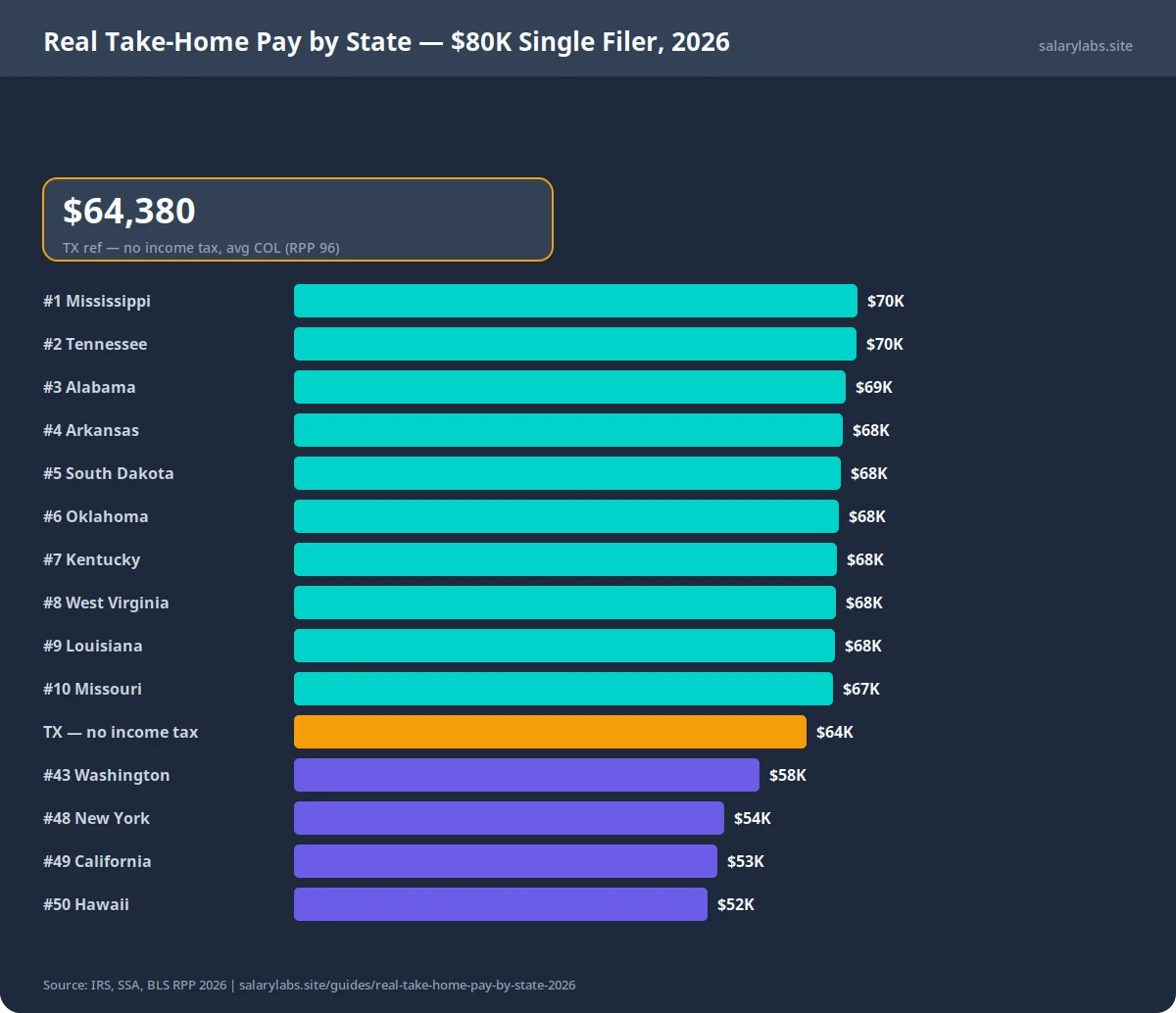
View data table
| Rank | State | Real Take-Home |
|---|---|---|
| 1 | Mississippi | $70,805 |
| 2 | Tennessee | $70,747 |
| 3 | Alabama | $69,375 |
| 4 | Arkansas | $68,945 |
| 5 | South Dakota | $68,708 |
| 6 | Oklahoma | $68,434 |
| 7 | Kentucky | $68,281 |
| 8 | West Virginia | $68,080 |
| 9 | Louisiana | $68,000 |
| 10 | Missouri | $67,732 |
| 11 | Texas (ref — no tax) | ~$64,380 |
| 43 | Washington | $58,527 |
| 48 | New York | $54,103 |
| 49 | California | $53,257 |
| 50 | Hawaii | $52,011 |
Ranked by post-tax, cost-adjusted dollars. All figures are state-level baselines, single filer, standard deduction.
| Rank | State | State Tax | Net (nominal) | RPP | Real Take-Home |
|---|---|---|---|---|---|
| 1 | Mississippi | $2,850 | $61,530 | 86.9 | $70,805 |
| 2 | Tennessee | $0 | $64,380 | 91.0 | $70,747 |
| 3 | Alabama | $3,400 | $60,980 | 87.9 | $69,375 |
| 4 | Arkansas | $2,950 | $61,430 | 89.1 | $68,945 |
| 5 | South Dakota | $0 | $64,380 | 93.7 | $68,708 |
| 6 | Oklahoma | $3,200 | $61,180 | 89.4 | $68,434 |
| 7 | Kentucky | $3,200 | $61,180 | 89.6 | $68,281 |
| 8 | West Virginia | $2,700 | $61,680 | 90.6 | $68,080 |
| 9 | Louisiana | $2,500 | $61,880 | 91.0 | $68,000 |
| 10 | Missouri | $3,150 | $61,230 | 90.4 | $67,732 |
Three observations. First, low-cost states without zero-tax status (Mississippi, Alabama, Kentucky) outperform several no-tax states because their cost-of-living advantage is larger than the state-tax saving. Second, Tennessee is the highest-ranked no-tax state and only barely edges Mississippi. Third, the spread inside the top ten is under $3,100 — a flatter top tier than nominal-only rankings suggest.
Bottom Ten Real Take-Home States at $80,000 (2026)
| Rank | State | State Tax | Net (nominal) | RPP | Real Take-Home |
|---|---|---|---|---|---|
| 50 | Hawaii | $5,400 | $58,980 | 113.4 | $52,011 |
| 49 | California | $4,200 | $60,180 | 113.0 | $53,257 |
| 48 | New York | $4,650 | $59,730 | 110.4 | $54,103 |
| 47 | New Jersey | $3,900 | $60,480 | 109.5 | $55,233 |
| 46 | Massachusetts | $4,000 | $60,380 | 108.0 | $55,907 |
| 45 | Connecticut | $3,800 | $60,580 | 107.4 | $56,406 |
| 44 | Maryland | $3,650 | $60,730 | 105.5 | $57,564 |
| 43 | Washington | $0 | $64,380 | 110.0 | $58,527 |
| 42 | Oregon | $5,800 | $58,580 | 100.0 | $58,580 |
| 41 | Vermont | $3,300 | $61,080 | 104.1 | $58,675 |
Washington is the noteworthy entry: it has zero state income tax but ranks 43 because Seattle-led cost of living absorbs the tax saving. Hawaii and California sit at the bottom for the obvious reasons — high state tax stacked on top of the highest-RPP environments.
The No-Tax State Honesty Check
Nine states levy zero ordinary state income tax: Alaska, Florida, Nevada, New Hampshire (wage income only), South Dakota, Tennessee, Texas, Washington, and Wyoming. New Hampshire taxes interest and dividends but not wage income, so it is included here for the wage-earner case. The headline read on these states is "$5,000 per year saved compared to a high-tax state." The full read is more interesting.
Tennessee, South Dakota, and Wyoming are the strongest cases. All three combine zero income tax with below-average cost of living, so the state-tax saving and the COLA advantage stack rather than cancel. The combined effect places them inside the national top 10. Florida and Texas are the in-between cases. Both have RPPs near the US average — Florida around 100.3, Texas around 96.5 — meaning the no-tax saving is real but not amplified. They land in the upper-middle of the national ranking, not the top.
Washington and Nevada are the cautionary cases. Washington's RPP near 110 makes Seattle-led housing absorb the tax saving entirely; the state ranks below the national median in cost-adjusted terms. Nevada's RPP varies sharply by metro — Las Vegas closer to average, Reno-Tahoe higher — so the no-tax win there is contingent on where inside the state the worker lives, a level of precision the state-level baseline cannot capture.
The High-Tax-State Counter-Narrative
California and New York are the most-discussed "expensive" states, and the state-level baseline does rank them at the bottom of real take-home. But the picture changes once the comparison narrows from state-level RPP to specific metro RPP. The BEA publishes parities at the metropolitan-area level for a reason: in-state variation can equal cross-state variation.
California's RPP averages around 113 statewide. San Francisco-Oakland-Berkeley sits closer to 130, while Bakersfield, Fresno, and Stockton come in below 100. A worker living in inland California experiences a different real take-home than the state-level average suggests. Same for New York: New York City metro near 122, but Buffalo, Rochester, and Syracuse below 95. The state-level number is a useful first-pass comparison; for an actual relocation decision, metro-level data is required.
The wage premium that high-COLA metros pay is the missing third variable. A software engineer role in San Francisco often pays 30-50% above the same role in Atlanta. The cost-adjusted take-home picture flips again once that premium is included. This guide deliberately holds salary constant at $80,000 to isolate the tax-and-COLA effect; the next guide in this series will model the wage-premium overlay.
Methodology Limitations
What this model captures: federal tax treatment for a single filer, FICA payroll tax, state income tax at the state-level baseline rate, and state-level RPP from the BEA. What it does not capture, listed honestly so readers know where the simplification ends.
- Local taxes. Some states (New York, Pennsylvania, Ohio, Maryland, Indiana, Michigan) allow city or county income taxes that can add 1-4 percentage points to the marginal rate. NYC's local tax adds roughly $1,800 at $80,000.
- Property tax. A homeowner in Texas at $80,000 income with a $300,000 home commonly pays $5,000-7,000 in property tax annually, a meaningful offset to the no-income-tax advantage. A renter in the same state does not.
- Sales tax exposure. Tennessee, Louisiana, and Arkansas all combine state and local sales tax above 9% in many cities. For a household spending most of disposable income on taxable goods, this further compresses the no-income-tax advantage.
- Employer benefits. Health insurance contribution differences, 401(k) match rates, and pre-tax transit or HSA programs all affect take-home. Those are employer-by-employer variables and outside a state-level model.
- Filing status. Married filing jointly with one earner produces a materially different picture: lower federal effective rate at $80,000 household income, different state treatment in some states. The model uses single filer because it produces the cleanest cross-state comparison.
- Federal credits. EITC, child tax credit, and education credits can shift federal tax owed substantially for eligible households; the model excludes them to keep the baseline comparable.
- Cost-of-living dimensions. RPP is a composite index covering rent, goods, and services. It does not separately weight childcare, healthcare premiums, or commuting cost, which can dominate the budget for specific household types.
None of these limitations break the state-level ranking, but they explain why an individual's personal take-home in any specific state may diverge from the baseline by several thousand dollars in either direction. The model is a first-pass comparison, not a relocation projection.
How to Use This in a Real Decision
Three honest applications. First, the directional gut-check: a job offer in a top-10 real take-home state is structurally more efficient than the same nominal offer in a bottom-10 state. The size of that gap is real. Second, the negotiation anchor: if a relocation is being proposed, the cost-adjusted delta is the number that should be discussed, not the nominal salary alone. Third, the planning frame: long-term savings projections that ignore state and cost-of-living variation overstate or understate compounding by 5-15% over a career, depending on which states are involved.
What this guide does not do: prescribe a state, recommend a relocation, or treat one ranking as a life decision. The numbers describe the structural environment; the personal decision belongs to the person making it.
Related Calculators and Guides
To run the math against your own numbers rather than the $80,000 baseline:
- Take-Home Pay Calculator — compute the tax layer for any salary, single or married filer
- US Salary Heatmap — interactive state-level visualisation of cost-adjusted purchasing power
- Tax Estimator — federal and state tax breakdown for a specific filing scenario
- Income Percentile Calculator — where a given salary lands in the national distribution
- Take-Home Pay Calculation Guide — the underlying formulas explained line by line
Sources
How the real-take-home figure was computed
Real take-home pay = (gross − federal income tax − FICA payroll tax − state income tax) ÷ state RPP × 100. The RPP-adjusted figure represents purchasing power in US-average terms.
Federal tax uses 2026 IRS brackets for the chosen filing status and the standard deduction. FICA is 6.2% Social Security on wages up to the 2026 wage base ($184,500) plus 1.45% Medicare on all wages. State income tax uses each state's top marginal rate applied at the income level when graduated, or the flat rate where applicable. The RPP comes from the BEA state-and-metro series.
IRS Rev. Proc. 2025-32 (federal brackets, standard deduction); SSA Contribution and Benefit Base (FICA); state revenue department publications; BEA Regional Price Parities.
Single filer, standard deduction, no dependents, no itemized deductions, no tax credits. The 2026 OBBBA amendments are reflected where applicable at publication time.
Local income taxes (NYC, Philadelphia, Columbus, etc.) are not modeled. Property and sales taxes are not included. Employer benefits (health, 401(k) match, HSA) are excluded because they vary by employer. The state-by-state comparison assumes the reader can relocate at will; many cannot.
- Federal tax brackets and standard deduction: IRS, 2026 Tax Year IRS Rev. Proc. 2025-32 (2026 tax year)
- FICA rates and Social Security wage base: SSA, 2026 Contribution and Benefit Base SSA Wage Base (2026)
- State income tax rates: state revenue/tax department publications, 2026 references
- Regional Price Parities by state: Bureau of Economic Analysis BEA RPP (Annual (most recent)) (2024 release, most recent available)
- Property and sales tax context: state-level published rate references
- Income Breakdown Calculator
Continue Reading