

Best States for Remote Workers 2026: Pay, Taxes & Quality of Life
Remote work changed the geography of American income. When your employer is in San Francisco but you live in Austin, you earn Silicon Valley wages while paying Texas taxes — and Texas has nostate income tax. That gap is the foundation of the remote work financial advantage.
But the calculation is more nuanced than income tax alone. Broadband quality, cost of living, healthcare access, and quality of life all affect whether a no-income-tax state is actually the best choice for you. Calculate your real take-home pay in any state to see the full picture.
The Income Tax Advantage
For a remote worker earning $120,000/year, the difference between living in California (13.3% top marginal state income tax) and Texas (0%) is roughly $12,000–$16,000 per year.That is real money — equivalent to 4–6 weeks of gross pay.See exactly what this means for your paycheck with the Take Home Pay Calculator.
Tax comparisons assume single filer, $120,000 W-2 income. State income tax savings calculated at marginal rates. Does not include local taxes, property tax, or sales tax differences.
Cost of Living: Where Your Remote Salary Goes Furthest
Income tax savings are only part of the picture. A no-income-tax state with expensive housing (San Diego, Seattle) may leave you worse off than a state with a modest income tax but affordable housing.
Cost-of-living indices relative to US average of 100. Housing cost is typically the largest single budget item for remote workers. Source: BLS, C2ER ACCRA Cost of Living Index.
Broadband Quality: Can You Actually Work From There?
Remote work requires reliable internet. Rural no-income-tax states may offer low taxes but unreliable broadband — which makes remote work impractical.
Coverage figures represent percentage of households with access to 100/20 Mbps broadband. Satellite (Starlink) is expanding options for rural areas. Source: FCC Broadband Data Map, 2025.
Best States by Priority
Maximum take-home pay
Texas, Florida, Washington, Nevada, Tennessee, New Hampshire, Wyoming, South Dakota, Alaska— the nine no-income-tax states. Texas and Florida also have large economies and job markets, making them the strongest choices for remote workers who want maximum net income.
Pay + quality of life balance
Arizona, North Carolina, Colorado — states with modest income taxes (2.5–4.75%) and growing tech economies. Lower COL than the coasts, good broadband, and enough economic density to find freelance or hybrid work locally.
Geographic arbitrage
Tulsa, Oklahoma; Bentonville, Arkansas; Chattanooga, Tennessee — cities with very low COL, growing remote-worker communities, and local incentives (Tulsa Remote, Tulsa Remote, etc.). A $100,000 remote salary goes further here than anywhere in coastal US.Compare your current location to these cities using the Take Home Pay Calculator.
Remote-work culture and community
Colorado, Austin TX, Raleigh NC, Phoenix AZ, Denver CO — cities with established remote-work culture, coworking spaces, and communities of distributed workers. Better for networking and avoiding isolation.
The Trade-offs No One Talks About
Property and sales taxes
No-income-tax states often make up revenue through higher property taxes and sales taxes. Texas has high property taxes. Florida's lack of income tax comes with higher sales taxes.Calculate the full tax picture, not just income tax — the Take Home Pay Calculator includes state income tax estimates for all 50 states.
Healthcare access
Rural no-income-tax states may have limited specialist healthcare access. A $150,000 salary in rural Wyoming with no income tax is less valuable if the nearest oncologist is 200 miles away.Check cost of living and healthcare access data for your target state.
School quality and family considerations
States with lower taxes may have lower public school funding. For remote workers with children,this is a significant hidden cost — private school tuition or property-tax-driven school quality differences matter over a 10–15 year horizon.
Run the Numbers
- Take Home Pay Calculator — Model your actual take-home after federal + state taxes in any state.
- Cost of Living by State — Compare purchasing power across all 50 states.
- Average Salary by State — Median pay data to benchmark your remote offer against local markets.
- No-Tax State Math, Honestly — The full tax trade-offs of moving to a no-income-tax state.
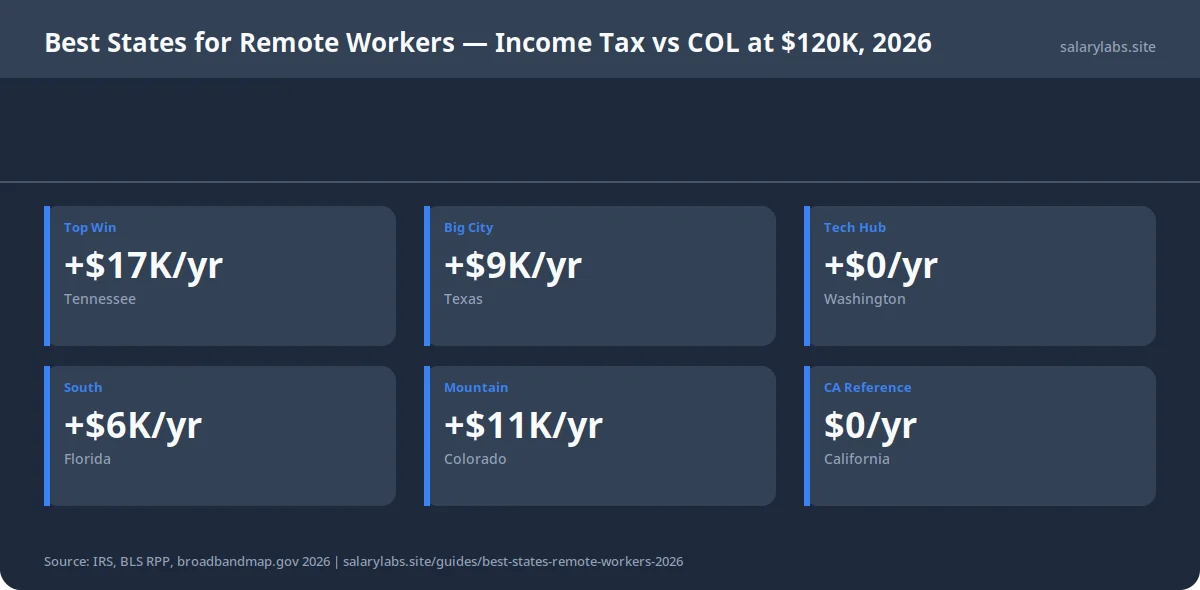
View data table
| Badge | Value | Label |
|---|---|---|
| Top Win | +$17K/yr | Tennessee |
| Big City | +$9K/yr | Texas |
| Tech Hub | +$0/yr | Washington |
| South | +$6K/yr | Florida |
| Mountain | +$11K/yr | Colorado |
| CA Reference | $0/yr | California |