How the Social Security wage base has tracked nominal wage growth, lagged inflation, and shifted the share of US workers fully covered by FICA over a generation.
Sources cited
2026 data
Updated June 2026
'IRS · BLS · SSA'
FICA Wage Base 1999-2026: 27 Years of Coverage Drift
Independent Salary Data Researcher
Published May 21, 2026
Updated Jul 21, 2026
Maintained by the author using IRS Publication 15-T, SSA wage-base announcements, and BLS OEWS data.
All calculator formulas are deterministic JavaScript — no AI inference in the numbers.
Content is reviewed for accuracy when tax figures are updated annually. See Methodology · Author Profile
The Social Security wage base is the dollar amount above which earnings escape the 6.2%
Social Security payroll tax in a given year. In 1999 it was $72,600. In 2026 it is $184,500.
That is a 154% increase across 27 years, slightly faster than inflation and broadly aligned
with national average wage growth. The annual headline rarely gets attention; the
multi-decade pattern is more interesting.
This guide pulls the full SSA wage base series, deflates it by CPI-U to show real-dollar
purchasing power, and overlays BLS earnings distribution data to estimate what share of US
workers were fully covered by Social Security tax in each year. The result describes how
structural FICA coverage has drifted over a generation, and why the conversation about
raising or removing the cap is fundamentally about that drift.
What this guide is. A 27-year longitudinal view of the FICA wage base, its
real-dollar trajectory, and earner coverage shifts. What it is not. An
argument for or against raising the cap, a forecast of future legislative action, or
personal tax advice.
$184,500
2026 Social Security wage base — earnings above this escape 6.2% SS tax
Source: Social Security Administration, 2026
Calculate how the FICA wage base affects your paycheck. Use the take-home pay calculator to see how Social Security and Medicare taxes reduce your gross salary, and the salary calculator to compare annual vs hourly equivalents.
$176,1002025 Social Security wage base (SS tax cap)
6.2%Employee SS rate — applied up to wage base only
No capMedicare 1.45% applies to all wages, no ceiling
The 1.45% Medicare tax applies to all wages with no cap. The 0.9% Additional Medicare tax
applies above $200,000 in wages for single filers, $250,000 for joint filers; that threshold
is not indexed to inflation. The 6.2% Social Security tax applies to wages up to the annual
wage base only.
Self-employed workers pay both the employee and employer portions of FICA, totalling 12.4%
Social Security on net earnings up to the wage base and 2.9% Medicare on all net earnings,
with the additional 0.9% surtax above the same income thresholds. The deduction for one-half
of self-employment tax partially offsets this on the federal return.
The wage base is set each year by SSA based on the National Average Wage Index two years
prior, multiplied by an indexing factor. The 2026 base of $184,500 was set using 2024 NAWI
data. The lag is structural; it does not reflect SSA "behind the curve," but rather the time
required to compile and publish the underlying wage data.
1999
$72,600 wage base
Starting point of this guide. SS covered most worker earnings at this level.
2009
$106,800 — first six-figure base
Crossed $100K mark. Annual cost for max earners reached $6,622.
2017
$127,200 — large single-year jump
One of the larger annual increases in the series. Affected higher-income workers visibly.
2023
$160,200 — inflation-driven surge
Post-COVID inflation pulled the AWI-indexed base sharply upward.
2026
$184,500 — current base
Max annual SS withholding: $11,439. Workers above this see a mid-year paycheck bump.
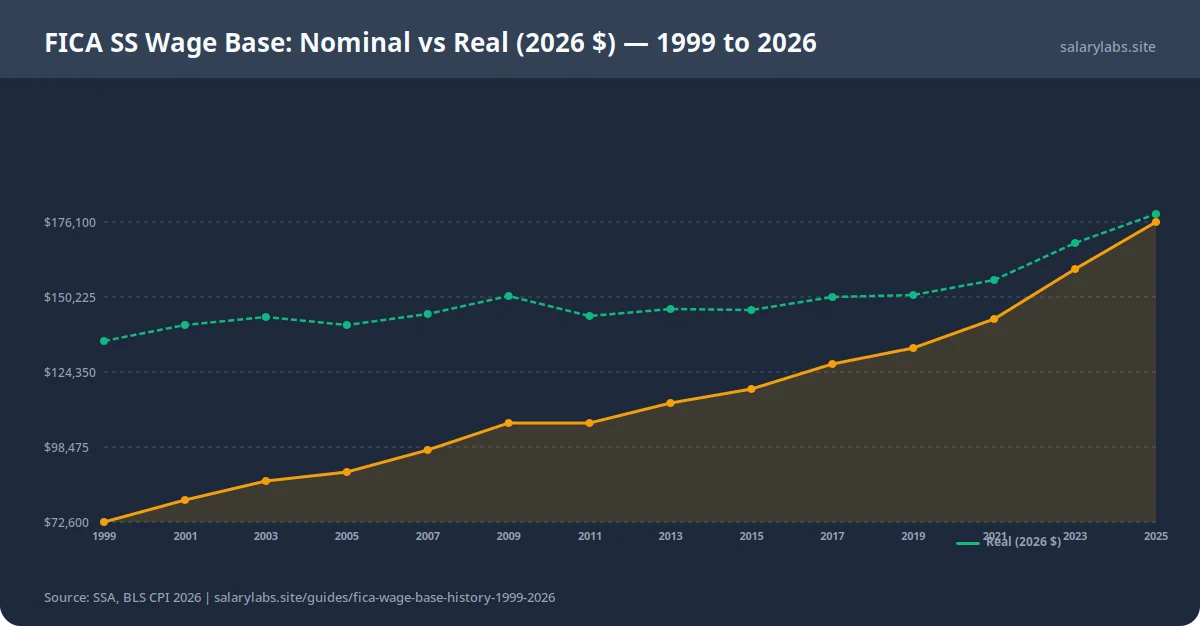
FICA SS Wage Base: Nominal vs Real (2026 $) — 1999 to 2026 — salarylabs.site
The 27-Year Series
Annual Social Security wage base, nominal and CPI-adjusted to 2026 dollars. CPI-U used for
deflation. Source: SSA Office of the Chief Actuary, Contribution and Benefit Base history.
Year
Wage base (nominal)
Wage base (2026 dollars)
YoY change (nominal)
1999
$72,600
$135,200
—
2000
$76,200
$137,300
+5.0%
2001
$80,400
$141,000
+5.5%
2002
$84,900
$146,400
+5.6%
2003
$87,000
$146,500
+2.5%
2004
$87,900
$144,100
+1.0%
2005
$90,000
$142,800
+2.4%
2006
$94,200
$144,800
+4.7%
2007
$97,500
$145,800
+3.5%
2008
$102,000
$146,800
+4.6%
2009
$106,800
$154,300
+4.7%
2010
$106,800
$151,800
0.0%
2011
$106,800
$147,200
0.0%
2012
$110,100
$148,800
+3.1%
2013
$113,700
$151,600
+3.3%
2014
$117,000
$153,400
+2.9%
2015
$118,500
$155,000
+1.3%
2016
$118,500
$153,000
0.0%
2017
$127,200
$160,800
+7.3%
2018
$128,400
$158,400
+0.9%
2019
$132,900
$160,900
+3.5%
2020
$137,700
$164,700
+3.6%
2021
$142,800
$163,200
+3.7%
2022
$147,000
$155,500
+2.9%
2023
$160,200
$162,700
+9.0%
2024
$168,600
$166,400
+5.2%
2025
$176,100
$169,000
+4.4%
2026
$184,500
$184,500
+4.8%
Three patterns stand out. The wage base is frozen for two years (2010-2011) and again for one
year (2016) when no NAWI growth was registered above the indexing threshold. The 2017 jump
of 7.3% is the largest single-year increase in the series, partly catching up from prior
flat years. The 2023 jump of 9.0% is the second-largest, reflecting the unusually strong
2021 NAWI used as the indexing reference.
The Real-Dollar View
Reading the table in 2026 dollars (CPI-U deflated) shows a different pattern than the
nominal series. Through the 2000s, the real wage base oscillated around $145,000 in 2026
dollars, sometimes ahead of inflation, sometimes behind. Through 2010-2016, real value
eroded as CPI growth outpaced wage-base increases, falling to roughly $147,000 by 2016. The
2017 catch-up restored some of that, then 2022 inflation drove a sharp drop to $155,500
before the 2023 NAWI catch-up restored the trajectory.
The 27-year real-dollar pattern is broadly flat with cyclical noise. Across the full period,
the wage base in 2026 dollars rose from approximately $135,200 to $184,500 — a real
increase of roughly 36%. That outpaces inflation by exactly the amount that real wages have
grown over the period. The wage base is, by design, anchored to nominal wages, not
inflation; the real-dollar growth reflects underlying wage growth, not policy generosity.
Coverage Drift: Who Is Fully Captured by FICA
The more interesting story is what fraction of US workers earn at or above the wage base in
a given year. SSA publishes annual estimates of this share. The percentage has drifted
modestly downward over the 27-year window, meaning a slowly growing share of total wage
earnings escapes the Social Security tax.
Year
Workers above wage base
Share of total wages above base
1999
~6.0%
~14%
2005
~6.0%
~16%
2010
~6.0%
~17%
2015
~6.5%
~17%
2020
~6.5%
~18%
2024
~6.5%
~18%
Two readings of this. The percent of workers above the base is roughly stable around 6-7%,
because the indexing rule is designed to hold that share constant. The percent of total
wages above the base has drifted up modestly because top-end earners' wages have grown
faster than the median, so a stable share of workers covers a slowly growing share of
dollars. This is the "uncovered earnings" trend that drives policy proposals to raise or
remove the cap.
For context: the share of total wages above the wage base in 1985 was approximately 10%.
The drift to roughly 18% by 2024 represents 27 years of slow accumulation, not a sudden
change. The wage base is doing its job — keeping the same share of workers fully covered —
but earnings inequality has put a growing fraction of dollar-volume outside the Social
Security tax base.
The Mid-Year Paycheck Effect
For a worker whose wages exceed the base, FICA withholding stops once year-to-date earnings
cross the threshold. Take-home pay rises noticeably from that paycheck onward. In 2026, a
worker earning $250,000 annual salary crosses the $184,500 threshold around late August
depending on bonus timing. From that point through year-end, their per-paycheck FICA
withholding drops from 7.65% to 1.45%, a 6.2-point bump in net per dollar of additional
earning.
The effect resets each January 1. High earners experience a January paycheck where FICA
withholding resumes at the full 7.65% (until 1.45% additional Medicare kicks in above the
threshold), creating a perceived take-home decline at year start that reverses by late
summer. Cash-flow planning for high-income workers should account for this seasonal pattern.
The Additional Medicare Tax of 0.9% applies above $200,000 single, $250,000 joint. This
threshold is not indexed, so it has captured a slowly growing share of earners since
enactment in 2013. Workers who crossed the $200,000 threshold for the first time in 2026
face a marginal Medicare exposure of 2.35% on each dollar above that point — a small but
durable bump.
What the History Implies for Forward Planning
Three structural points worth noting, none of them advisory.
First, the wage base will continue to grow with the National Average Wage Index. Workers
whose annual income is currently near the base ($175,000-$190,000 range) should expect to
remain near it in real-dollar terms for the foreseeable future, with the threshold rising
4-5% per year in normal conditions and faster in years following high NAWI growth.
Second, the Additional Medicare Tax threshold of $200,000 single is not indexed. Each year
of nominal wage growth pushes more earners across that threshold. A worker who is below
$200,000 today and projects nominal income growth of 4% per year will cross the threshold
in 5-7 years even without a promotion. The 0.9% surtax is a small but accumulating exposure
across a career.
Third, policy proposals to raise or remove the wage base have appeared in nearly every
Social Security solvency conversation since the 1990s. None has passed in the 27-year
window covered by this guide. Workers should plan against the existing rule structure but
be aware that the rule is not permanent.
Limitations
Approximate distribution figures. The "workers above wage base" and
"share of wages above base" columns are SSA-published estimates with methodology
documented in OASDI Trustees Reports. Year-by-year figures move slightly with revisions.
Self-employed handling. Self-employment net earnings count toward the
wage base but follow the SE-tax rule structure, not the W-2 employee rule. The series in
this guide reflects the W-2 rule for clarity.
Multiple-job earners. A worker with multiple W-2 jobs whose combined
earnings exceed the wage base may have over-withholding refunded via the federal return.
The mechanics are documented in IRS Form 1040 instructions; the guide does not model that
case.
State payroll taxes. State-level disability, unemployment, and
family-leave payroll taxes have separate wage base rules that differ from the federal
Social Security base. The guide focuses on federal FICA only.
Indexing methodology changes. The current NAWI-based formula has been in
place since 1979. Pre-1979 indexing used a different rule; comparisons to that earlier
period are not directly apples-to-apples.
The FICA History Rule
The wage base has grown 154% since 1999. Your paycheck feels it most in the year it jumps.
High earners above the wage base get a mid-year take-home pay increase when SS withholding stops. Low-to-middle earners stay fully captured all year. The gap between those two groups has widened as the base climbed.
Published 2026-05-21. The 2027 wage base is announced by SSA in October 2026; this guide
will be updated within 14 days of that release. Updates logged in
Methodology.