
When Hourly Pay Beats Salary: A Decision Framework

The naive comparison is simple: divide an annual salary by 2,080 hours and call it the hourly equivalent. It is also wrong in most real cases. Overtime exposure, FLSA classification, benefits coverage, and scheduling stability all change the picture, sometimes by 20-30%. This guide builds a four-persona framework that runs the math honestly for each pattern most US workers actually encounter.
The framework is decision-supportive, not advisory. It produces a structural answer for each persona, with the math shown. Personal circumstances — health insurance preferences, family obligations, geographic constraints, risk tolerance — are out of scope and belong to the individual making the decision.
What this guide is. A four-persona decision framework with explicit math for converting between hourly and salary in real conditions, including overtime and classification effects. What it is not. A career recommendation, a job change endorsement, or legal advice on FLSA classification.
The Conversion Math, Done Right
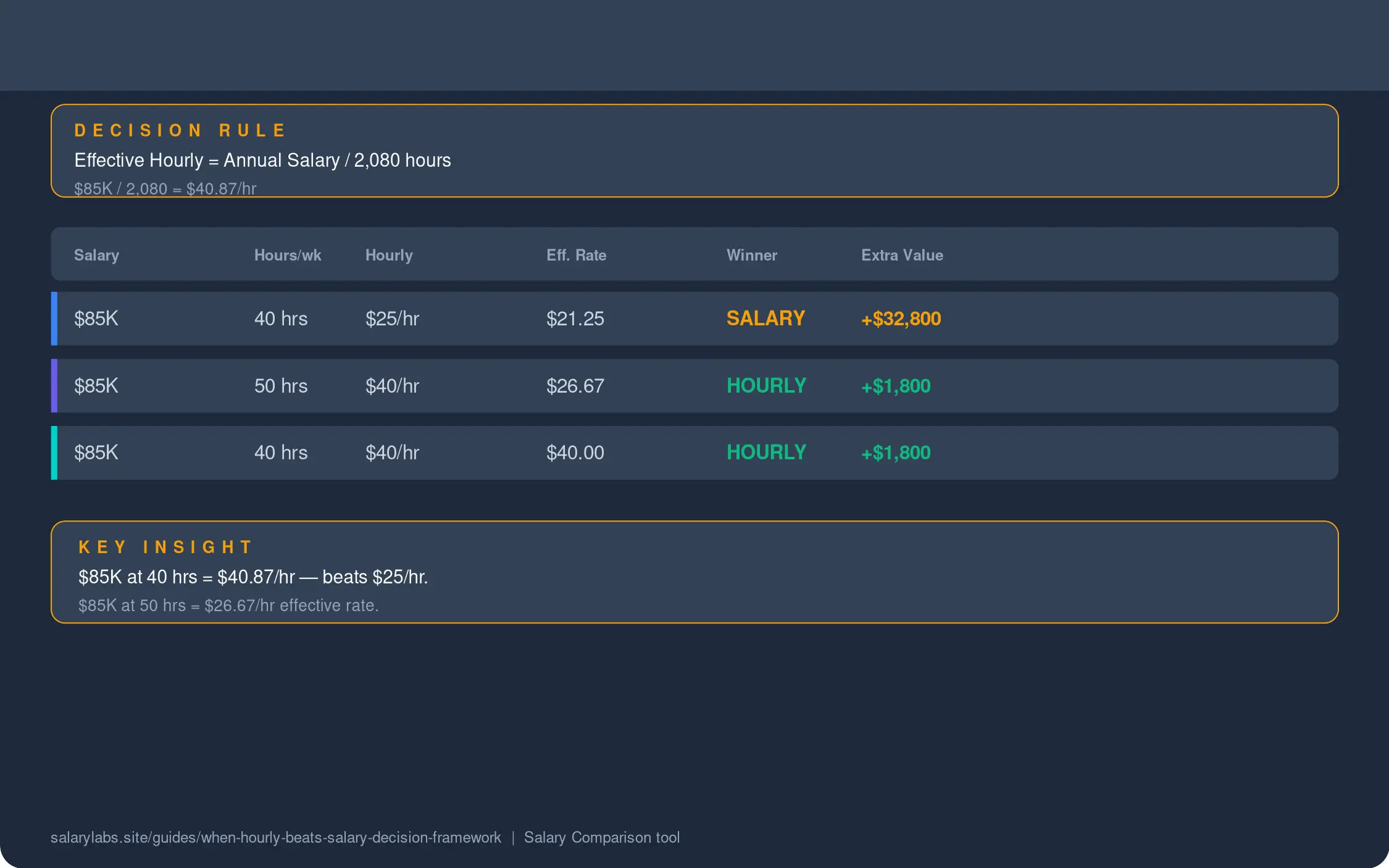
The textbook formula is annual ÷ 2,080 for salary-to-hourly and
hourly × 2,080 for hourly-to-annual. Both assume 40 hours per week, 52 weeks per
year, no unpaid leave, no overtime. They are useful only as a starting reference.
The honest formula adjusts for actual conditions. For a salaried worker, real hourly rate is
annual ÷ (actual weekly hours × weeks worked). For an hourly worker, real annual
pay is (regular hours × rate) + (OT hours × rate × 1.5) minus any unpaid hours.
The two formulas describe the same compensation but answer different questions: what is this
hour worth, and what is this year worth.
Both views are needed because they identify different problems. The hourly view exposes uncompensated overwork. The annual view exposes scheduling instability. A worker comparing offers should run both for each option and treat the gap between them as the volatility cost of that role.
Why Naive Comparison Misleads
Three traps are common enough to deserve naming.
The 2,080-hour fiction. Most full-time exempt workers do not work 2,080 hours; they work somewhere between 1,950 and 2,400. The lower number reflects paid leave taken; the higher reflects unpaid overwork. A salary divided by 2,080 produces a rate that neither the upper nor lower case actually receives.
The benefits glossover. Employer-paid health insurance, employer 401(k) match, and PTO are rarely valued precisely when comparing offers. A $90,000 salaried role with $14,000 of benefits is not directly comparable to a $90,000 hourly role with $5,000 of benefits, even at identical hours.
The variance blindness. Hourly workers face hour-cut and seasonal-slowdown risk that salaried workers face only as full layoff risk. The expected-value calculation should weigh both the median outcome and the bottom-quartile outcome. Comparing only median hours hides the volatility cost.
- 2,080-hour conversion overstates real rate
- Extra hours absorbed without extra pay
- Benefits usually stronger
- Predictable paycheck every period
- Career path often clearer
- Every extra hour has a dollar value
- 1.5× overtime legally required above 40 hrs
- Hours can vary — income volatility risk
- Benefits thinner for part-time/contract
- Freelance adds SE tax and benefits gap
Persona 1: Software Engineer, Exempt Salary, 50-Hour Weeks
Setup: $130,000 annual salary, exempt under FLSA professional exemption, working 50 hours per week with two weeks of paid time off used. Total annual hours actually worked: 50 × 50 = 2,500.
| Metric | Naive value | Real value |
|---|---|---|
| Stated hourly equivalent | $62.50 | — |
| Real hourly rate (actual hours) | — | $52.00 |
| Pay gap on extra 10 hrs/wk | $0 | $0 (no OT) |
| Effective annual pay | $130,000 | $130,000 |
The structural reality: this worker is paid for the 40-hour version of the job and works the 50-hour version. The real hourly rate is 17% below the stated equivalent. To break even on that 10-hour gap, the role would need to pay $156,000 to match $62.50 on actual hours, or working hours would need to drop to 40.
The hourly comparison: an FLSA non-exempt role at $62.50/hour working 50 hours per week would generate $130,000 in regular pay (40 × 50 × $62.50) plus $46,875 in overtime (10 × 50 × $93.75), for $176,875 total. The exempt-salaried path is leaving $46,875 on the table per year, in pure pay terms.
The structural answer for this persona: hourly wins on pure pay if the role allows the same hours and the worker can secure non-exempt classification. In tech, that classification rarely exists. The realistic counterfactual is renegotiating to fewer hours rather than switching pay structures.
Persona 2: Hospitality Worker, Hourly, 35-Hour Average Week
Setup: $22 per hour, non-exempt under FLSA, scheduled for 35 hours per week with seasonal bumps to 45 hours during peak weeks (10 weeks per year). Two weeks unpaid time off used. Total annual hours: (42 weeks × 35) + (10 weeks × 45) = 1,470 + 450 = 1,920.
| Metric | Standard week | Peak week | Annual total |
|---|---|---|---|
| Hours @ regular rate | 35 | 40 | 1,870 |
| Hours @ OT rate (1.5x) | 0 | 5 | 50 |
| Regular pay | $770 | $880 | $41,140 |
| Overtime pay | $0 | $165 | $1,650 |
| Total pay | $770 | $1,045 | $42,790 |
Three observations. First, the FLSA overtime premium is real money: $1,650 across the year from 50 OT hours, equivalent to a 4% wage bump on the regular pay base. Second, the under-40-hour standard week means total annual income is significantly below a 40-hour-week assumption. The naive comparison "this is a $45,760 job" (at 40 hours × 52 weeks × $22) overstates by $2,970. Third, the volatility is asymmetric: the worker captures upside on peak weeks but absorbs the cost of any standard-week shortfall.
The salaried comparison: a salaried equivalent paying $42,790 annually with no overtime mechanics would be flat across the year. The hourly path produces a mix of $770 weeks and $1,045 weeks. Same total, different cash-flow profile. Workers who need predictable monthly cash flow may rationally prefer the salaried equivalent at slightly less total pay; workers who can absorb variance may rationally prefer the hourly path because peak-week earnings compound.
The structural answer for this persona: hourly with FLSA overtime is preferable when peak weeks are reliable and the worker has financial buffer for standard-week shortfalls. Salary with similar total compensation is preferable when scheduling stability matters more than peak-week upside.
Persona 3: The State Threshold Case
Setup: $59,000 salary, currently classified as exempt, working 45 hours per week. The federal FLSA salary threshold reverted to $35,568 after a Texas federal court vacated the 2024 update in State of Texas v. DOL (Nov 15, 2024), so this worker clears the federal floor by a wide margin. But several states set their own thresholds well above federal: California (2× state minimum wage, around $68,640 in 2025), Washington (around $69,305 in 2025), New York (around $58,500 in downstate counties), and Colorado (around $55,000 in 2024). A $59,000 worker in California is exempt under federal law but non-exempt under state law and must be paid hourly with overtime. The state of employment changes the entire classification, not the salary.
| Scenario | Status | Hours/wk | Annual pay | Real $/hr |
|---|---|---|---|---|
| Federal-only state, current | Exempt salaried | 45 | $59,000 | $25.21 |
| CA / WA, reclassified, same hrs | Non-exempt hourly | 45 | $66,084 | $28.24 |
| CA / WA, reclassified, capped at 40 | Non-exempt hourly | 40 | $58,968 | $28.36 |
The math: at the equivalent hourly rate of $28.36 (calculated as $59,000 ÷ 2,080), reclassified hours of 45 with 5 OT hours produce regular pay of $58,968 plus overtime of $7,116, totalling $66,084. The reclassified worker working the same 45 hours captures $7,084 more annually than the exempt version.
The catch is what happens to scheduling. Some employers respond to FLSA reclassification by reducing scheduled hours to 40 to avoid the overtime cost. The reclassified worker working 40 hours captures $58,968 — about $32 less than the exempt baseline at 45 hours. The exempt worker absorbs the 5 extra hours; the reclassified-and-capped worker does not work them. Same employer cost, different worker experience.
The structural answer for this persona: state of employment can flip the classification entirely. A worker offered the same $59,000 nominal package in San Francisco vs Atlanta is in two different legal regimes. Reclassification is materially better for the worker if hours stay the same, materially neutral if hours are capped at 40. Federal-only states leave the worker exempt by default at this salary level.
Persona 4: The Freelance Hourly Setting Market Rate
Setup: independent contractor setting an hourly rate to bid on projects. Target take-home equivalent of a $90,000 W-2 salary. Self-employment tax exposure changes the math meaningfully.
A W-2 worker earning $90,000 pays 7.65% in employee FICA ($6,885), and the employer pays the matching 7.65%. A self-employed worker pays the full 15.3% on net self-employment earnings, half of which is deductible above the line on the federal return. Practical effect: the freelancer needs to gross approximately 8-9% more to net the same take-home as the W-2 worker.
Plus benefits. Health insurance, retirement match, paid time off, sick leave, and unemployment insurance all need to be self-funded. A reasonable estimate is 25-35% of W-2 salary covering these benefits indirectly, though the exact figure depends on family situation and risk tolerance.
The combined adjustment: a freelance hourly rate equivalent to a $90,000 W-2 salary should be
computed as $90,000 × 1.30 (benefits) × 1.085 (SE tax) ÷ 2,080 hours = $61.05/hour
as a working baseline. Lower than that, and the freelancer is structurally underpriced
compared to a W-2 alternative.
The structural answer for this persona: freelance hourly rates that look attractive in isolation are often below the W-2-equivalent breakeven once SE tax and benefits are accounted for. The naive 2,080-hour conversion of "$90,000 ÷ 2,080 = $43/hour" is a 30-40% undercount of the rate needed to match the same take-home.
Decision Tree
The four personas can be summarised as a single decision tree, applied in order.
- Is the role required to be non-exempt under FLSA? If the salary is below the federal threshold and the duties test does not satisfy an exemption, the worker must be hourly with overtime. The decision is structural, not preferential.
- Are scheduled hours stable above 40 per week? If yes, exempt salaried loses on pure pay (the OT premium captures real value). If no, exempt salaried may be preferable for predictability.
- Do total compensation calculations include benefits at honest values? Hourly comparisons that ignore healthcare, retirement match, and PTO often misprice the comparison by 20-30%.
- Is the comparison W-2 vs 1099? If yes, gross up the 1099 rate by approximately 30-40% before comparing.
- Does the worker need scheduling predictability or is variance acceptable? Preference question; the math does not answer it.
Limitations
- State law variation. California, Alaska, Nevada, and a handful of other states have daily-overtime rules that differ from the federal weekly-overtime baseline. The framework uses federal rules; state rules can shift the math materially.
- Healthcare exposure. The hidden cost of high-deductible plans for hourly workers, or COBRA exposure during transitions, is excluded from the framework. For workers with significant healthcare needs, this can dominate the decision.
- Unemployment insurance. Hourly W-2 workers who are laid off generally receive unemployment benefits; 1099 freelancers historically did not, though policy evolution since 2020 has changed parts of this. Multi-year career risk is unevenly distributed across the four personas.
- Tax treatment timing. Self-employed workers face quarterly estimated tax and SE tax deductibility timing that can affect cash flow even when the annual after-tax result is similar.
- Market norms. Some industries do not offer the comparison structurally. Tech does not generally offer hourly versions of senior roles. Hospitality does not generally offer salaried versions of line roles. The framework assumes the comparison is available; reality often constrains the choice.
Related Calculators and Guides
- Salary-to-Hourly Calculator — convert annual to hourly with adjustable hours-per-week
- Hourly-to-Salary Calculator — project annual income from hourly rate plus realistic hours
- Burnout Calculator — quantify the hidden hourly-rate cost of long weeks for salaried workers
- Overtime Calculator — FLSA-style 1.5x multiplier on weekly OT hours
- Salary vs Hourly Guide — the broader explainer this framework refines
- How Overtime Pay Works — FLSA rules and state overlay
Sources
- FLSA overtime rule and salary threshold: US Department of Labor Wage and Hour Division
- FICA and self-employment tax framework: IRS Self-Employment Tax
- Salary threshold history and 2026 reference: DOL Overtime Rulemaking
- Negotiation Script Generator
- Hourly vs salaried compensation trends: BLS Current Population Survey