Texas, Florida, Tennessee and seven other no-income-tax states aren't always the winner once property tax, sales tax, and cost-of-living enter the math.
Sources cited
2026 data
Updated June 2026
'IRS · BLS · SSA'
Independent Salary Data Researcher
Published May 21, 2026
Updated Jul 21, 2026
Maintained by the author using IRS Publication 15-T, SSA wage-base announcements, and BLS OEWS data.
All calculator formulas are deterministic JavaScript — no AI inference in the numbers.
Content is reviewed for accuracy when tax figures are updated annually. See Methodology · Author Profile
"Move to Texas and save $5,000 a year on taxes." It is the somewhat headline that travels well
and survives unexamined. The first part is sometimes true. The full picture, with property
tax, sales tax, and cost of living modelled in, is more interesting and meaningfully less
conclusive. This guide walks through the math state by state and identifies the household
profiles where no-income-tax is a clear win, where it is roughly neutral, and where the
headline saving evaporates.
Key terms to know first:
State income tax — a percentage taken from your wages by the state, on top of federal tax. Nine states charge zero.
Property tax — annual tax on your home's value. Texas has some of the highest property tax rates in the country.
Sales tax — added to purchases at the register. Tennessee's combined state + local sales tax averages ~9.55%, among the highest in the US.
Cost of living (COL) — how far your dollar goes for housing, food, and services. Measured by the BEA's Regional Price Parity (RPP) index.
Hall income tax — Tennessee previously taxed interest and dividend income; it was fully eliminated in 2021.
Source data: state revenue department references for income tax rates, Tax Foundation
published median property tax data, state and local sales tax tables, and BEA Regional
Price Parities for cost-of-living overlay. Citations are inline and at the end of the guide.
What this guide is. A structural comparison of the nine no-income-tax
states against equivalent income alternatives, accounting for property tax, sales tax,
and cost of living. What it is not. A relocation recommendation, a tax
strategy plan, or a substitute for personal financial advice.
0%
State income tax — Alaska, Florida, Nevada, South Dakota, Tennessee, Texas, Washington, Wyoming, New Hampshire
9 states in 2026 — but no-income-tax ≠ no hidden costs
9States with no individual income tax in 2026
2–3%Typical higher sales tax offset in no-income-tax states
VariesNet benefit depends on spending, property, and COL
$80,000 Income — Net Advantage vs California (Renter)
Tennessee
+$16,960Tax saving + strong COL advantage
Texas
+$8,960Tax saving mostly offset by high property tax
Florida
+$6,180Near-average COL limits amplification
Alaska
+$1,800Above-avg COL erases most of the saving
Washington
−$1,920Seattle COL turns no-tax into a net loss vs CA
No tax state ≠ more take-home automatically. The blackboard above shows why — use the take-home pay calculator to compare your exact salary in two states and see the real net difference.
The Nine States and What They Substitute For Income Tax
Each state replaces income tax revenue through a different mix. Reading these as "free
money" misses the offset.
Alaska. No state income tax, no state sales tax. Funded historically by
oil revenue plus a Permanent Fund Dividend that pays residents annually (~$1,300-$1,800
in recent years). Property taxes vary by borough. Local sales tax in some areas. Cost of
living above the US average due to logistics.
Florida. No state income tax. State sales tax of 6%, plus local additions
averaging 1-1.5%. Property tax statewide median around 0.86% of home value. Cost of
living near US average statewide; significantly above in Miami, Naples, Sarasota.
Nevada. No state income tax. State sales tax of 6.85%, local additions
push effective rate to 8-8.4% in Las Vegas and Reno metros. Property tax effective rate
around 0.55% — among the lowest nationally. Cost of living moderate statewide, higher in
Lake Tahoe area.
New Hampshire. No tax on wage income. NH repealed its Interest and
Dividends tax effective Jan 1, 2025 (HB 2, 2023 session); before repeal it taxed
unearned investment income but not wages. Highest property tax effective rate in the
country at approximately 1.93% — the wage earner pays no state income tax but a
homeowner pays substantially in property tax.
South Dakota. No state income tax. State sales tax 4.2%, local additions
bring it to 6-7% in cities. Property tax near US median. Cost of living below US average.
One of the cleanest no-tax cases.
Tennessee. No tax on wage income. The Hall income tax on interest and
dividends was eliminated in 2021. State sales tax 7%, local additions average 2.55%
bringing combined to 9.55% — among the highest in the country. Property tax near US
median. Cost of living below US average.
Texas. No state income tax. State sales tax 6.25%, local additions push
combined to 8.20% on average. Property tax effective rate around 1.68% — fourth highest
nationally. The property tax counter-balance is the most-discussed element of the Texas
case.
Washington. No state income tax on wages. Capital gains tax of 7% on
gains over $262,000. State sales tax 6.5%, local additions push combined to 9.4%. Property
tax around 0.93%. Cost of living near US average statewide, significantly above in
Seattle metro.
Wyoming. No state income tax, no corporate income tax. State sales tax
4%, local additions push to 5.5%. Property tax 0.61%. Cost of living near US average,
below average in most regions outside Jackson and Cheyenne.
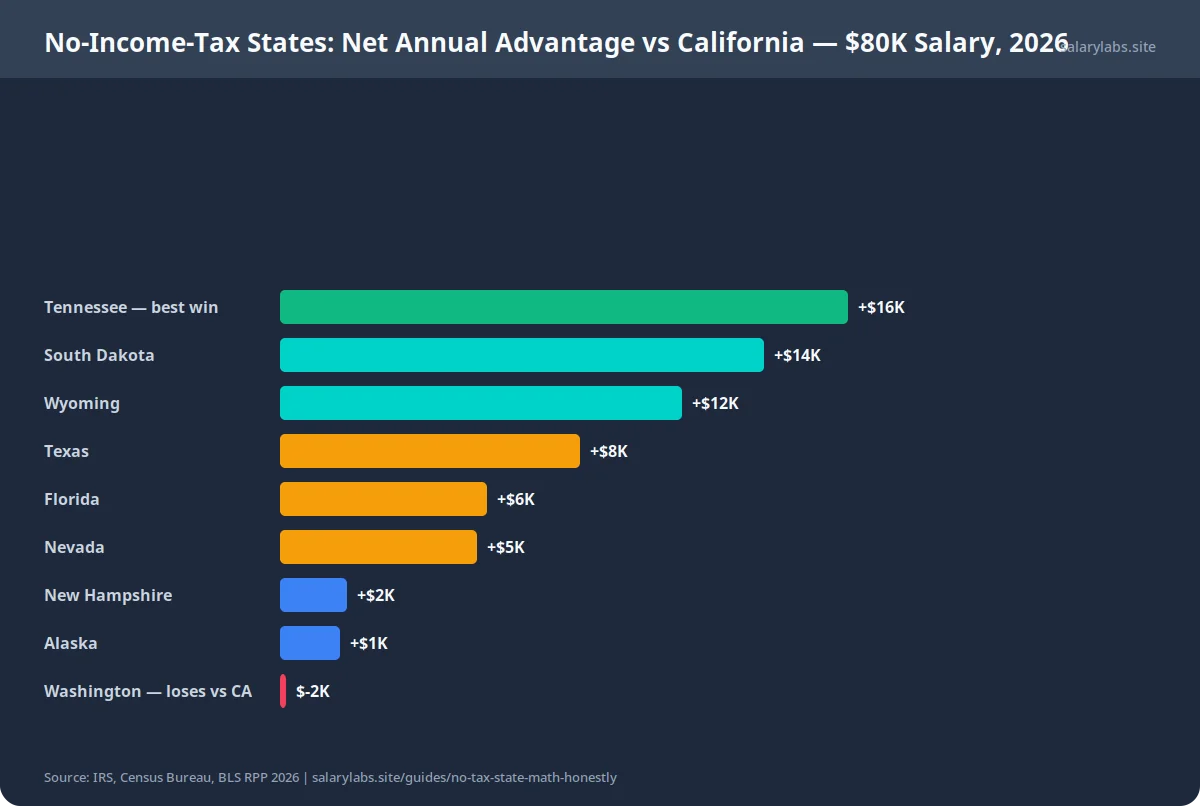
No-Income-Tax States: Net Annual Advantage vs California — $80K Salary, 2026 — salarylabs.siteView data table
No-Income-Tax States: Net Annual Advantage vs California — $80K Salary, 2026
Rank
Job / Category
Value
1
Tennessee — best win
16960
2
South Dakota
14470
3
Wyoming
12000
4
Texas
8960
5
Florida
6180
6
Nevada
5890
7
New Hampshire
2000
8
Alaska
1800
9
Washington — loses vs CA
-1920
The Headline vs Net Savings, At $80,000 Income
The starting comparison: an $80,000 wage earner pays roughly $4,000 in California state
income tax, the highest-tax baseline. Versus zero in any no-income-tax state. So the
headline saving is approximately $4,000.
The full picture once property tax, sales tax differential, and cost of living go in. The
table below shows annual net advantage versus California for a single filer earning $80,000,
renting (no property tax exposure), spending 30% of income on taxable goods.
State
Income tax saved
Sales tax delta
COLA effect
Net advantage
Tennessee
+$4,000
−$540
+$13,500
+$16,960
South Dakota
+$4,000
−$330
+$10,800
+$14,470
Wyoming
+$4,000
−$200
+$8,200
+$12,000
Texas
+$4,000
−$340
+$5,300
+$8,960
Florida
+$4,000
−$220
+$2,400
+$6,180
Nevada
+$4,000
−$310
+$2,200
+$5,890
Alaska
+$4,000
+$200
−$2,400
+$1,800
New Hampshire
+$4,000
+$200
−$2,200
+$2,000
Washington
+$4,000
−$520
−$5,400
−$1,920
Reading: Tennessee, South Dakota, and Wyoming compound the income-tax saving with cost-of-
living advantages, producing net advantages 3-4x the headline. Florida, Texas, and Nevada
produce more modest net advantages — the income-tax saving dominates but is not amplified.
Alaska and New Hampshire are roughly neutral once their above-average cost of living offsets.
Washington is the case where the headline saving disappears entirely; for the renter at
$80,000, choosing Washington over California produces a net disadvantage despite zero state
income tax.
The Property Tax Wedge: Texas Specifically
Renting and owning produce sharply different no-tax-state outcomes, more than headlines
acknowledge. A homeowner in Texas with a $300,000 home pays approximately $5,040 per year
in property tax at the 1.68% effective rate. That is more than the entire $4,000 income tax
saving versus California. Adjust for Texas's lower cost of living and the homeowner is
slightly ahead, but the property tax has eaten most of the headline benefit.
A renter in the same state pays no property tax directly, though landlords pass some through
via rent. The renter captures more of the income-tax saving as net advantage. The same
no-tax-state status produces meaningfully different outcomes for renter vs owner.
The math gets sharper at higher home values. A homeowner in Texas with a $600,000 home pays
approximately $10,080 in property tax — far above the income tax savings versus any
reasonable comparison state. The structural answer for high-value homeowners considering
Texas: the no-income-tax win evaporates, and depending on home value, the move may be a net
tax-burden increase compared to a moderate-tax state with normal property taxes.
Two Worked Examples
Example 1: $100,000 California vs $100,000 Texas, single filer, renter
Item
California
Texas
Gross salary
$100,000
$100,000
Federal income tax
$13,449
$13,449
FICA
$7,650
$7,650
State income tax
$5,335
$0
After-tax annual
$73,874
$79,209
Sales tax (30% spend on taxable)
~$1,776
~$1,968
After-sales-tax annual
$72,098
$77,241
RPP (state level)
113.0
96.5
Real purchasing power
$63,803
$80,043
The renter at $100,000 in Texas captures roughly $16,200 more in real purchasing power than
the equivalent in California. Income tax saving alone was $5,335. The cost-of-living gap
contributes the larger share — roughly $10,900 — and the sales tax counter-balance is small
at this income level.
Example 2: $80,000 Florida vs $80,000 Tennessee, single filer, renter
Item
Florida
Tennessee
Gross salary
$80,000
$80,000
Federal + FICA
$15,621
$15,621
State income tax
$0
$0
After-tax annual
$64,379
$64,379
Sales tax (30% taxable spend)
~$1,440
~$1,840
After-sales-tax annual
$62,939
$62,539
RPP (state level)
100.3
91.0
Real purchasing power
$62,750
$68,724
Florida and Tennessee both have zero state income tax. The 4-percentage-point sales tax
difference (FL ~7%, TN ~9.55%) costs the Tennessee resident roughly $400 per year on $24,000
of taxable spending. But Tennessee's cost-of-living advantage (RPP 91 vs FL 100.3) produces
roughly $6,000 of additional real purchasing power. Tennessee wins clearly despite the
higher sales tax burden, because cost of living dominates at this income level.
When No-Income-Tax IS a Clear Win
The pattern across the math: no-income-tax states are clear wins under specific conditions,
not universally.
High income with low housing exposure. A high-income renter, or a
high-income owner of a small property in a no-tax state, captures the full income-tax
saving without giving most of it back through property tax.
High savers. Workers who save 30%+ of after-tax income are exposed less
to sales tax, so the high-sales-tax counter-balance in Tennessee or Texas is muted. The
income-tax saving compounds into investment growth rather than getting spent at the
register.
Below-COLA-average residence within state. A renter or modest owner in
Wichita Falls, Texas, or Memphis, Tennessee, captures the cost-of-living advantage that a
Houston or Nashville resident does not get. The state-level number averages across both;
actual experience depends on metro choice.
Retirees with primarily investment income. Investment income is taxed
differently across states. New Hampshire and Washington tax investment categories that
wage states tax through ordinary income brackets. This guide focuses on wage earners; the
retirement case requires a separate analysis.
When It Is NOT a Clear Win
Modest income in high-property-tax metro. A $60,000 worker buying a
$300,000 home in suburban Texas pays roughly the same property tax as the income tax saving
on that income level. Net effect close to zero, before adjusting for any cost-of-living
difference.
High consumption-to-income ratio. A worker spending 50% of income on
taxable goods in Tennessee absorbs the high sales tax meaningfully. The income-tax saving
and the sales-tax cost net to a smaller advantage than headlines imply.
Seattle or Las Vegas housing. Cost of living in these specific metros can
more than offset the no-income-tax saving. Workers comparing offers should not rely on
state-level math when the actual housing decision is in a high-COLA metro.
Family-of-four with school-age children. School quality, childcare, and
local services are funded differently across states. Property tax in Texas and New
Hampshire correlates with strong public school quality in suburban districts; lower
property tax in some no-tax states correlates with weaker public services. The trade-off
is real even when the dollar math is favorable.
Key Takeaways
The headline saving is real but limited. Nine states levy zero income tax, which can save $2,000–$5,000+ per year versus high-tax states — but the gap is often smaller than headlines suggest.
Property tax and sales tax recover the revenue. Texas, Tennessee, and New Hampshire each offset income-tax freedom through other taxes. Always look at the full tax picture, not just the income tax line.
Cost of living often matters more than taxes. Tennessee and South Dakota combine no income tax with below-average living costs — producing net advantages 3–4× the headline tax saving. Washington and Nevada lose the advantage due to high COL in their major metros.
Renter vs owner changes the math significantly. A Texas homeowner pays ~$5,000–$10,000/year in property tax on a median home, which can exceed the entire income-tax saving versus California. Renters capture more of the benefit.
There is no universal winner. The "best" state depends on your income level, housing situation, spending habits, and whether you live in an urban or rural area within that state.
Limitations
Homestead exemptions and rebates. Texas homestead exemption, Florida's
Save Our Homes assessment cap, and similar programs reduce effective property tax
meaningfully for primary residences. The $5,040 Texas property tax estimate above is the
unprotected case; the protected long-term resident may pay materially less.
Local income taxes. Some no-state-income-tax states permit municipal or
county wage taxes (rare in this group, but Alaska boroughs and a few others). The guide
uses state-level baseline and notes these as outliers.
Estate and inheritance tax. Several no-income-tax states (Washington
notably) impose estate tax that affects inheritance planning. Outside the wage-earner
scope of this guide.
Healthcare premium variation. ACA marketplace premiums vary by state
regardless of income tax status. A move that captures income tax saving but increases
healthcare premiums can be net negative for self-employed or non-employer-sponsored
coverage cases.
Tax volatility. No-income-tax status is not constitutional in most
states. New Hampshire is phasing out its interest-and-dividends tax; Alaska's PFD has
varied dramatically by year. Building a long-term plan on a current rule structure
carries some forward risk.
Related Tools and Guides
Clear Win Profile
Texas (renter, high income)
~$4–7K/yr
Income tax saving minus modest sales tax. Works when you rent and don't own expensive property.
Neutral Profile
Texas (homeowner)
Near zero
Property tax at ~1.8% effective rate often recaptures 60–80% of the income-tax saving.
Negative Profile
Tennessee (low saver)
May cost more
9.55% avg sales tax consumes the income-tax saving for workers who spend most of their income.
The Honest Rule
No income tax is a real benefit. It is rarely as large as the headline suggests.
The savings are real for high earners who rent, save aggressively, and live in lower-cost
metros within the state. For everyone else, property tax, sales tax, and cost of
living each take a cut of the headline saving. The math is worth running before
treating "no income tax" as a deciding factor.
Published 2026-05-21. Tax Foundation publishes annual updates to property tax and sales tax
data; this guide will be revised when new tables drop. Updates logged in
Methodology.