

How to Ask for a Raise in 2026: What the Data Says
Range built from market data. Never start with the stretch — anchor on the target and let the employer move you toward it.
Most raises do not happen because people do not ask. The ones that do happen often fail because the ask arrives without numbers. Here is the framework that works — grounded in what actually moves comp decisions, not motivational platitudes.
Why Raises Are a Numbers Game
Before you schedule the meeting, two things need to be locked: your market anchor and your documented contribution. Without those, the conversation defaults to vibes — and vibes do not change payroll systems.
Data from BLS Occupational Employment and Wage Statistics (OEWS) tells you where your role sits in the market. The gap between what the market pays and what you currently earn is the math that makes HR care. The documented wins are the proof that closes the gap between "sounds reasonable" and "approved."
Build the Case Before You Book the Meeting
The worst time to discover you need market data is during the conversation. The worst time to scramble for examples is when your manager is waiting for your answer. Prepare three things before the meeting:
- Market anchor. BLS OEWS for your role, level, and state. Levels.fyi for tech. Industry-specific surveys where available. One clean data point beats three vague comparisons.
- Your documented contribution. Not "I work hard" — specific outcomes with scope. A project led, a metric improved, a problem solved. Dollar-denominated where possible.
- Your ask in writing. What you want, backed by why the market supports it, with one concrete example of value. Written asks are harder to deflect and easier for managers to champion upward.
The strongest ask does not feel like a demand. It feels like calibration: "Here is what I found, here is where I sit relative to the market, here is what I have delivered. I want to discuss closing the gap."
What the Data Actually Says About Raise Outcomes
ADP data tracking 14.8 million workers shows that stayers averaged 4.5% pay growth in 2025-2026. Job changers averaged 6.3%. Internal promotions — a real level bump, not a title change — typically deliver 10-25% base increase in one move, with the compounding effect of future raises anchored to the new higher base.
SHRM research shows employees who negotiate with documented performance data receive outcomes 12-18% higher than those who ask without specifics. CareerBuilder data puts the average negotiated raise at 18.83% above the initial offer. The common thread across all studies: specificity wins.
What the data does not support: asking for a raise because you are underpaid and deserve more. "Deserve" is not an argument in a comp review. Market rate and documented contribution are.
Timing: When Raises Actually Happen
Most companies finalize salary increase budgets 60-90 days before the fiscal year. For calendar-year companies, September through November is when HR and finance are actively shaping the numbers. A conversation in January is a conversation about next year's budget — not this one.
Annual review cycles are the formal moment, but they are also the crowded moment. The informal conversation six months earlier — before the budget is locked — is often more productive. It gives your manager time to build the case upward and incorporate market data before decisions are made.
Bad timing that kills otherwise good asks: after layoffs have been announced, during company financial stress, during team restructuring, or right after a failed project. Context matters. The ask does not exist in isolation.
What to Say — and How to Say It
The script is not the point. The frame is. Three moves that work:
What kills the ask: personal financial pressure, vague timelines ("I have been here three years"), demands without data, comparing yourself to colleagues (compensation confidentiality makes this fragile), and asking for a number without knowing the budget or band.
What to Do When the Answer Is No — Or When There Is No Budget
A no on base salary is often a no on base salary specifically. The next moves that do not require headcount approval:
- Performance bonus or spot bonus — one-time payments are easier to approve than base adjustments.
- Earlier review cycle — a six-month check-in beats waiting a full year when the math is close.
- Title change with updated job description — a title bump with scope documentation sets up the next cycle with better framing.
- Professional development budget — certifications, courses, conferences that directly support the next-level work are a development investment, not a raise in disguise.
- Scope expansion with a clear review date — document what "performing at the next level" means, then review in 90 days with a specific number attached.
The worst outcome is accepting a no on base and walking out without getting the standard documented. "What would close this gap in six months, and can we put that in writing?" is a complete response to a no. It preserves the conversation without burning the relationship.
What the Research Says About Raise Timing and Frequency
CareerBuilder data on negotiation outcomes: candidates who come in with one specific ask — anchored to data — receive better outcomes than those who present a vague wish list. One number, one market reference, one documented contribution. Keep it tight.
The frequency question matters more than most people think. Annual raises are the norm — but annual is the frequency of the formal review, not the frequency of calibration conversations. Informal check-ins every quarter keep the conversation alive and prevent the "surprise review" dynamic where both sides walk in unprepared.
If your company does an annual review, the raise ask should not be a surprise. The data and the ask should already be on the table before the formal meeting. The meeting is where the decision gets documented, not where the argument gets made.
Using SalaryLabs Tools to Build the Case
Three SalaryLabs tools are built for exactly this prep phase:
- Income Percentile Calculator — see where your current pay sits nationally. Use this to calibrate whether your ask is above, at, or below the market rate for your role and experience level.
- Salary Calculator — translate a raise percentage into take-home pay impact. "$6,000 more base" becomes more concrete when you see the biweekly net difference.
- Negotiation Script Generator — draft the framing before the meeting. The tool helps organize the case, not replace the conversation.
What Not to Do in a Raise Conversation
- Do not mention personal expenses, inflation, rent increases, or cost of living. These framing arguments do not move HR systems.
- Do not compare your salary to colleagues, even if you know the number. Compensation transparency is a company culture question, not a negotiation tactic.
- Do not anchor too low out of fear of rejection. Employers expect negotiation. CareerBuilder data shows 73% of hiring managers expect a counter on compensation. The same logic applies to raises.
- Do not make ultimatums without a realistic backup. Threatening to leave without a real offer or a genuine reason you would follow through weakens your position.
- Do not accept a no on base salary as a no on everything. It is a no on one line item. Ask what is movable.
The Compounding Effect Worth Knowing
A $5,000 raise does more than add $5,000 to this year's compensation. It usually lifts future raises, employer retirement contributions tied to base, and the starting point of every subsequent negotiation. The salary conversation compounds in a way that a bonus does not.
This is why market-rate accuracy matters. Being $8,000 below the 50th percentile in year one with no ask for three years means the compounding gap is worth far more than $8,000 times three. The math favors the person who asks early and adjusts frequently over the person who waits for the "perfect moment."
The perfect moment is whenever you have market data, documented contribution, and a manager willing to listen. All three of those can be assembled in the same two-week window.
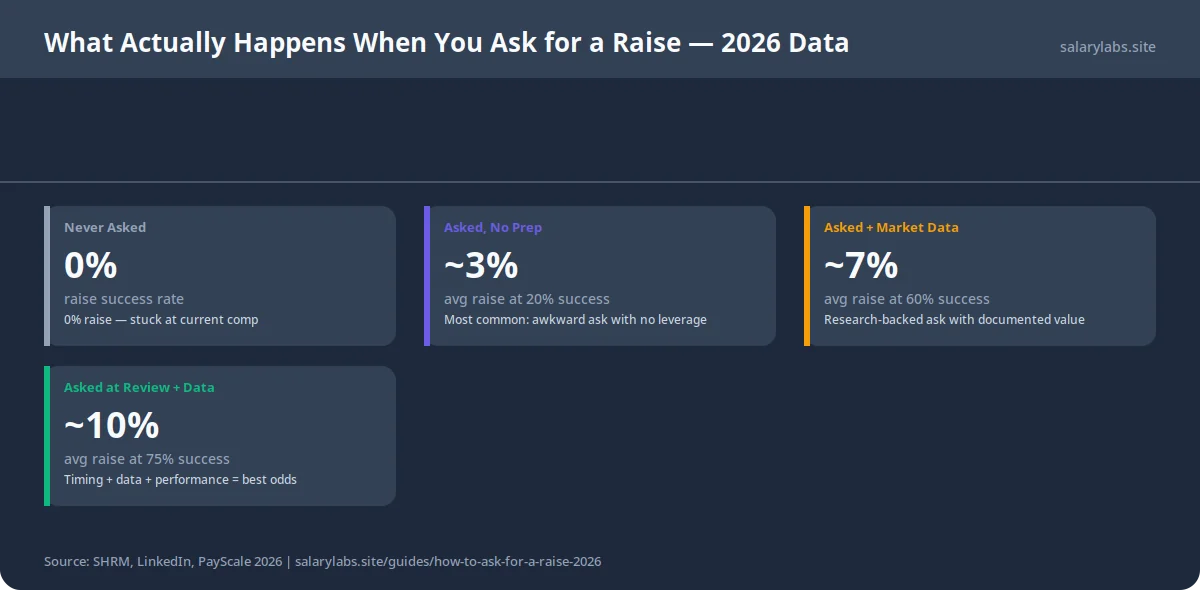
View data table
| Badge | Value | Label |
|---|---|---|
| Never Asked | 0% | raise success rate |
| Asked, No Prep | ~3% | avg raise at 20% success |
| Asked + Market Data | ~7% | avg raise at 60% success |
| Asked at Review + Data | ~10% | avg raise at 75% success |