
What Is a Good Benefits Package Worth?

Benefits make up approximately 24% of total compensation for US workers according to the Bureau of Labor Statistics Employer Costs for Employee Compensation. Yet most job seekers evaluate benefits as vague perks rather than concrete dollar values. This guide shows you how to translate each major benefit into an annual dollar figure so you can add it to your base salary and compare offers on equal terms.
The job offer evaluation guide covers the full compensation stack for comparing two offers. This guide goes deeper on the benefits layer — what each benefit is worth, how to calculate it, and which benefits should not be assigned a simple dollar value.
What counts as a benefit
A benefit is any form of compensation that is not direct cash wages. Some benefits reduce your costs. Some provide cash or cash-equivalent value. Some are conditional on your usage. Some are uncertain in value. The first distinction is between employer-paid benefits (value you receive without action) and employer-matched benefits (value you receive when you contribute).
According to the BLS, total benefits for civilian workers average approximately 30% of total compensation, but the breakdown varies significantly by employer size, industry, and role level. The components that are most quantifiable are health insurance, retirement contributions, and paid leave.
Benefits with clear dollar value
The following benefits have reasonably estimable annual dollar values based on published survey data. Each is listed with its typical value range and the source used.
- Employer health insurance contribution — the employer's share of your premium, paid directly to the insurer. You do not see this on your paycheck, but it is real compensation value.
- 401(k) employer match — cash deposited into your retirement account by your employer, dollar for dollar or percentage-matched.
- HSA employer contribution — direct cash deposits to your health savings account by some employers, above and beyond the match.
- Paid time off — salary value of vacation, sick, and holidays.
- Life insurance and disability — employer-paid coverage that protects your income.
- Tuition and education reimbursement — employer-paid for approved programs.
- Home office and wellness stipends — direct cash or expense reimbursements.
Employer health insurance contribution
This is typically the largest single benefit dollar value that most workers overlook. According to the Kaiser Family Foundation 2025 Employer Health Benefits Survey, the total annual premium for single coverage averages $9,325. Workers pay approximately $1,440 (16%) through payroll deductions. The employer pays the remaining $7,885 per year on your behalf.
For family coverage, the total annual premium averages $26,993. Workers pay approximately $6,850 (26%) and employers pay the remaining $20,143 per year.
These figures are employer contributions — cash the employer sends to the insurance company on your behalf. They are part of your total compensation even though they do not appear on a paycheck. When comparing two job offers where one includes employer health coverage and one does not, the employer's contribution is a real dollar value.
Important caveats: the employer's contribution is real value, but it is not equivalent to cash. You receive it only if you use the health plan. A high-deductible health plan with a $7,885 employer contribution still requires you to pay the deductible and out-of-pocket maximum in a bad health year. The employer's contribution buys you insurance coverage, not a deposit to your bank account.
The healthcare premium guide covers plan types, deductibles, HSA mechanics, and the Section 125 pre-tax shelter effect in detail. For benefits valuation purposes, use the employer's dollar contribution as the starting figure.
401(k) employer match
The 401(k) match is the most immediately quantifiable employer benefit. According to Vanguard's How America Saves 2025, the average employer match is approximately 4.6% of salary, and the median is 4.0%. The most common match formula is $0.50 per dollar on the first 6% of salary — meaning you must contribute 6% to receive the full 3% match.
At a $125,000 salary: a 4% match is worth $5,000 per year. At $80,000: a 4% match is worth $3,200 per year. This is guaranteed money — you receive it simply by contributing enough to capture it. There is no performance condition.
The key questions are: what percentage of salary does the match represent, and what percentage of salary must you contribute to receive the full match? Vesting schedules also matter — some employers require you to stay for up to three years before you own the matched funds. Vesting affects whether you can count the full match as guaranteed value in a short tenure scenario.
The retirement contribution guide covers the full stacking strategy — HSA, IRA, 401(k) limits, and Roth vs Traditional decisions. For benefits valuation, the single number you need is the employer match percentage applied to your salary.
Paid time off
PTO has a direct cash equivalent. Each vacation day at a $125,000 salary is worth approximately $480 in gross pay (based on 2,080 work hours per year, 40 hours per week). Ten extra vacation days equals approximately $4,800 in gross salary equivalent.
Sick leave is harder to value because it is conditional — you receive it when you are sick. However, the financial value of employer-provided sick leave versus self-insuring sick days is real. According to BLS data, approximately 73% of civilian workers have some form of paid sick leave. The number of days and accrual rate vary widely.
Federal holidays (typically 10–11 per year) are guaranteed paid time off that adds to the total PTO value. The cash equivalent of federal holidays at $125,000 salary is approximately $4,800–$5,280 per year.
PTO value example: a worker with 20 vacation days, 10 sick days, and 10 federal holidays receives the equivalent of approximately $19,200 in gross pay as paid time off at $125,000 salary. The value is implicit in base salary — it does not add to your pay stub — but it represents real compensation you receive without working.
HSA employer contributions
Some employers make direct cash contributions to employees' health savings accounts, above and beyond the premium contribution. According to the SHRM 2025 Employee Benefits Survey, average employer HSA contributions are approximately $1,059 per year for individual coverage and $1,735 per year for family coverage. These are maximum cap figures — actual employer HSA contributions vary, with approximately 75% of employers making some HSA contribution.
Note: the SHRM figures represent average maximum caps that employers set, not necessarily what employees receive. The actual average contribution is somewhat lower. Additionally, employer HSA contributions reduce the employee's deductible and out-of-pocket exposure, which has a separate value that depends on how much healthcare the employee uses.
Other quantifiable benefits
Life insurance
Employer-provided life insurance is typically a flat amount (one or two times salary) at no cost to the employee. According to BLS data, approximately 62% of civilian workers have access to employer-paid life insurance. The median flat amount is approximately $15,000 for full-time workers. Employer cost is typically $0.04–$0.08 per $1,000 of coverage per year — meaning a $50,000 policy costs the employer approximately $200–$400 per year. This is real compensation value, though modest compared to health or retirement benefits.
Short-term and long-term disability
Short-term disability (STD) covers a portion of salary during illness or injury. Approximately 35% of civilian workers have employer-provided STD. The median replacement rate is approximately 60% of salary, with a typical maximum benefit of $584 per week for up to 26 weeks. Long-term disability (LTD) covers salary beyond the STD period — approximately 34% of workers have access, with a median replacement of 60% of salary and a typical maximum of $8,000 per month.
Valuing disability benefits requires probability estimates of disability occurrence, which vary significantly by age and occupation. As a rough framework: employer-paid STD and LTD combined are worth approximately 0.5–2% of salary in actuarial value, depending on the coverage terms and your age bracket.
Tuition and education reimbursement
Approximately 46–48% of employers offer tuition assistance or education reimbursement. The SHRM 2025 survey reports an average maximum reimbursement of approximately $4,764 per year. The IRS excludes the first $5,250 per year from taxable income. For workers who use the full reimbursement, this is worth approximately $4,764 in education value, of which the first $5,250 is tax-free.
Home office and wellness stipends
For remote or hybrid roles, home office stipends are increasingly common. According to SHRM research, average monthly home office stipends range from $50 to $150, translating to approximately $600–$1,800 per year. Structured remote work perk programs average approximately $850 per year, with premium programs reaching $3,000–$5,000 annually.
Wellness benefits average approximately $1,142 per year per employee at organizations that offer them, according to Mercer research. Commuter benefits (transit and parking) are capped by the IRS at $340 per month each ($4,080 per year combined), though only approximately 12% of employers offer an employer-paid subsidy.
Worked example: valuing one benefits package
Consider a mid-level professional earning $125,000 with the following benefits package. This example uses current-year survey data.
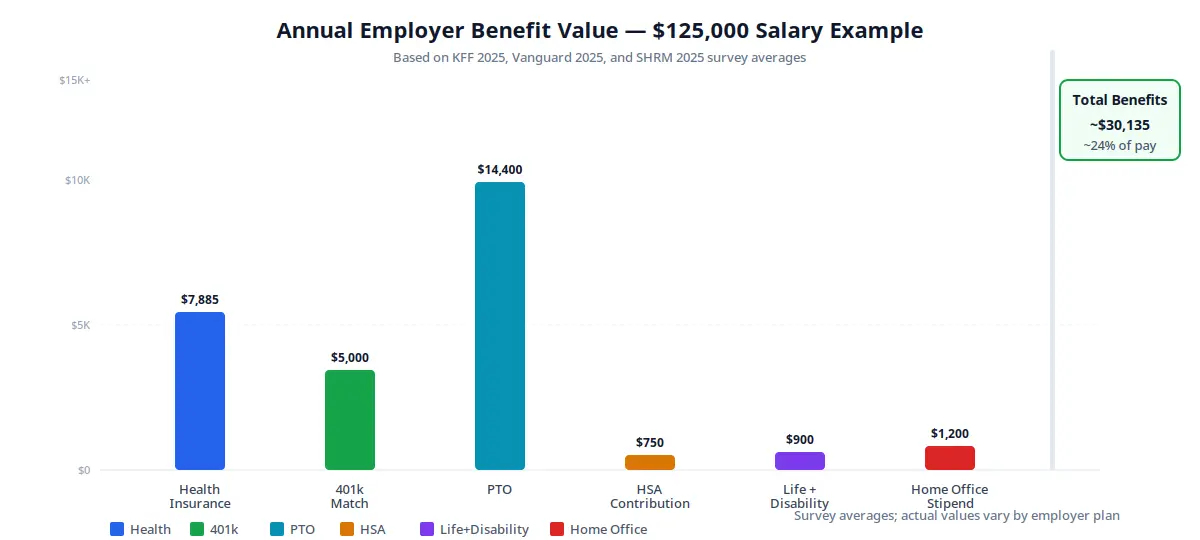
View data table
| Benefit | Employer Pays (Annual) | Notes |
|---|---|---|
| Health insurance (single) | $7,885 | KFF 2025 average employer contribution |
| 401(k) match (4%) | $5,000 | Vanguard 2025 average; requires employee contribution |
| HSA employer contribution | $750 | SHRM 2025 midpoint estimate (varies widely) |
| Paid time off (20 days + 10 holidays) | $14,400 | 48 days x $300/day; value is implicit in base salary |
| Life insurance (1x salary) | $400 | $0.06 per $1,000 at $125,000 coverage |
| STD + LTD | $500 | Actuarial estimate; ~0.4% of salary |
| Home office stipend | $1,200 | $100/month average; not all employers offer this |
| Total non-salary compensation | ~$30,135 | ~24% of total compensation |
The total compensation for this example is approximately $125,000 in salary plus $30,135 in employer-paid benefits — or roughly $155,135 in total compensation. The salary is $125,000. The benefits are worth $30,135.
The PTO value ($14,400) is the largest single benefit component by dollar amount, but it is worth noting that PTO value is implicit in base salary — you receive it simply by being employed. The health and retirement contributions are the components that most differ between employers and most affect total compensation comparisons.
How to compare two benefits packages
When evaluating two job offers, create a simple comparison table with the following columns:
- Benefit — the name of the benefit
- Offer A value — employer dollar contribution
- Offer B value — employer dollar contribution
- Difference — A minus B
- Notes — conditions, caps, vesting
Fill in the benefits where you have specific dollar figures from each employer. Where you do not have specific data (for example, a vague "comprehensive benefits package"), use the survey averages above as a reasonable estimate and note the uncertainty.
The most important comparison is typically health insurance plus 401(k) match, which together represent $12,000–$27,000 in annual employer-paid value depending on salary and plan design. The employer health contribution alone averages $7,885 for single coverage — a figure that most candidates never see written down.
Benefits that should not be assigned a simple dollar value: mental health resources, employee assistance programs, gym memberships (worth depends on usage), professional development opportunities (worth depends on your career stage and goals), and company culture factors. These are real value but not easily quantified.
Questions to ask about benefits
Before accepting an offer, request specific dollar figures for the following:
- What is the employer contribution to my health premium? Ask for the per-paycheck deduction amount for the plan at your coverage level (single, employee + spouse, family). The employer contribution is total premium minus your payroll deduction.
- What is the 401(k) match formula? Percentage of salary, dollar-for-dollar or tiered, and what contribution percentage is required to receive the full match.
- Is there an employer HSA contribution? Dollar amount per pay period or per year, and whether it is available immediately or after a waiting period.
- What is the PTO accrual rate? Days per year at your level, and whether it rolls over or expires.
- What life insurance and disability coverage is provided? Flat amount or multiple of salary, and the maximum benefit amounts.
- What is the tuition reimbursement maximum per year? And what programs qualify.
- Is there a home office, wellness, or commuter stipend? Dollar amount per month or per year, and whether it is taxable income.
Sources and methodology
- BLS Employer Costs for Employee Compensation — December 2025 — benefits as percentage of total compensation by occupation and industry.
- Kaiser Family Foundation Employer Health Benefits Survey 2025 — employer and worker premium contributions, single and family coverage.
- Vanguard How America Saves 2025 — 401(k) match rates, contribution patterns, plan design.
- SHRM Employee Benefits Survey 2025 — HSA employer contributions, tuition reimbursement, wellness, home office stipends.
- BLS National Compensation Survey — Employee Benefits in the United States, March 2025 — life insurance, STD, LTD access and prevalence.
- IRS Publication 969 — HSA rules and contribution limits.
- IRS Publication 15-B — commuter benefits and fringe benefit taxation.
All figures in this guide are based on published survey averages unless otherwise noted. Benefits vary by employer, plan design, salary level, and individual circumstance. This guide does not constitute financial, tax, or legal advice. Consult a financial advisor for personalized benefits evaluation.